



By AIDAN KNIGHT
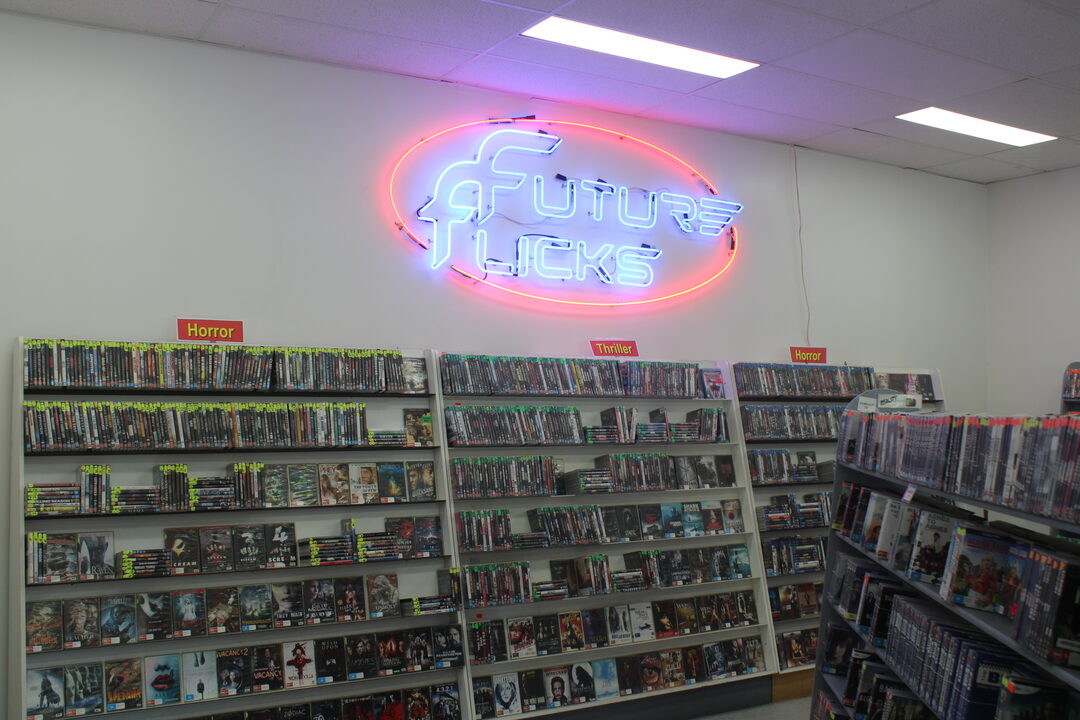
MOE’S fabled Future Flicks video store, one of the last of its kind, has relocated into a space nearly twice the size of its previous space.
Previously housed at 35 Kirk Street, Moe, owner Ricky Dyt took the store back to his origins at 30 George St, just around the corner.
Rick’s story with Moe’s video shops goes back almost 40 years. He first opened a small store in 1987, moved to a bigger venue in 1989, and has since shifted locations around town, including a stint next to Michael’s Golden Hen.
“It’s gone full circle,” said Rick, who remembers the VHS heyday, the rise of DVDs, and the waves brought by streaming services.
The Express stopped by the reopening – fittingly for a video store, just in time for Halloween.
Rick was adding finishing touches to the new layout after carting 120 boxes of films and TV shows from one shopfront to the other, a task staff described as “ache-inducing”. Store assistant Angie Smith said she was sad to leave the old site behind, but excited to work in a bigger, brighter space conveniently close to the train station and the main drag of town.
Moving wasn’t just about size. Rick explained he was contemplating retirement after selling the old building, but was persuaded to keep going by loyal regulars and the “strong, supportive Gippsland base.”
“People like the nostalgic feel coming into a traditional video store,” he shared, describing the effort invested in preserving neon signs from past shops and recreating the classic atmosphere.
“I wanted to get that ’90s feel,” he said, crediting a long-time friend for repairing and refurbishing the neon lighting.

He reminisced about customers making a comeback, drawn in by nostalgia, and curious newcomers from the passing crowd.
Express readers may also remember a story from October last year on the filming of Netflix series Videoland taking place in Future Flicks, the success of which may possibly see the series return to the new store for a second season (The Express’ own Liam Durkin was an extra in this film).
A career in an almost mythical institution such as Future Flicks comes with many stories.
Rick recalls two of his most consistently hired films, one of which also became the most stolen.
“I remember we got Pulp Fiction and Muriel’s Wedding in on the same day,” he said.
The store’s long-standing policy was to keep new-release VHS tapes behind the counter for the first six weeks – so valuable were these hotly sought-after films. Yet, on this occasion, a slip in routine proved costly.
“The girl working, she just went and put Muriel’s Wedding up. I said, ‘where’d you put the tapes?’ and she said, ‘I left them in the cover’.”
While Rick was busy preparing Pulp Fiction for display, the students made off with five out of six copies of Muriel’s Wedding. Thankfully, the equally popular Pulp Fiction was spared, thanks only to Rick’s sharp eye and prompt reaction – he hadn’t yet put the storied Quentin Tarantino title out when the theft occurred.
In an era dominated by streaming, Rick says Future Flicks survives by offering what algorithms cannot: personal touch, recommendations, and community.
“It fluctuated through the ’90s, then DVD came in and business picked up. When streaming arrived, it really hit us, but we found ways to coexist,” he said.

By keeping prices affordable, he outcompeted streaming services for certain films, sometimes even beating their prices.
The store’s business now splits 50/50 between sales and rentals, with a “personalised service” like custom orders and holding titles for regulars, features the owner describes as a major draw. On a global scale, cinema attendance is now estimated to be at 68 per cent of 2019 (pre-pandemic) levels, and video stores are even less of a trend.
While streaming platforms command the convenience and algorithmic ease of modern viewing habits, what’s lost is the human element – someone at the counter recommending a film you wouldn’t have clicked on, the serendipity of browsing a shelf, or the communal thrill of choosing something together. It’s an experience every generation should have at least once.
In 2001, Australia had around 2600 video rental stores. By around 2016, that number had fallen to less than 750 stores, and more recent reporting (via Metro Magazine) suggests the number is now below 500, and the last updated census data (2022) showed that only 160 people were employed in the video rental industry.
Now, there is only one store left in the whole of Melbourne, and regional communities like Colac have said goodbye to their last surviving stores after COVID, never to return. Rick estimates around five stores are left in the entire state.
When streaming rules our screens, it’s nice to step into a place that feels like Futurama coming to life – bringing back a little analogue magic in a digital world.