


By KATRINA BRANDON
INDIVIDUAL and collective innovation is spread throughout Gippsland.
At the 2025 Women in Dairy Discussion Group (WID) end-of-year luncheon, about 200 people gathered at the All Occasions Wedding and Functions Gippsland in Traralgon to celebrate innovation and pathways created by individuals.
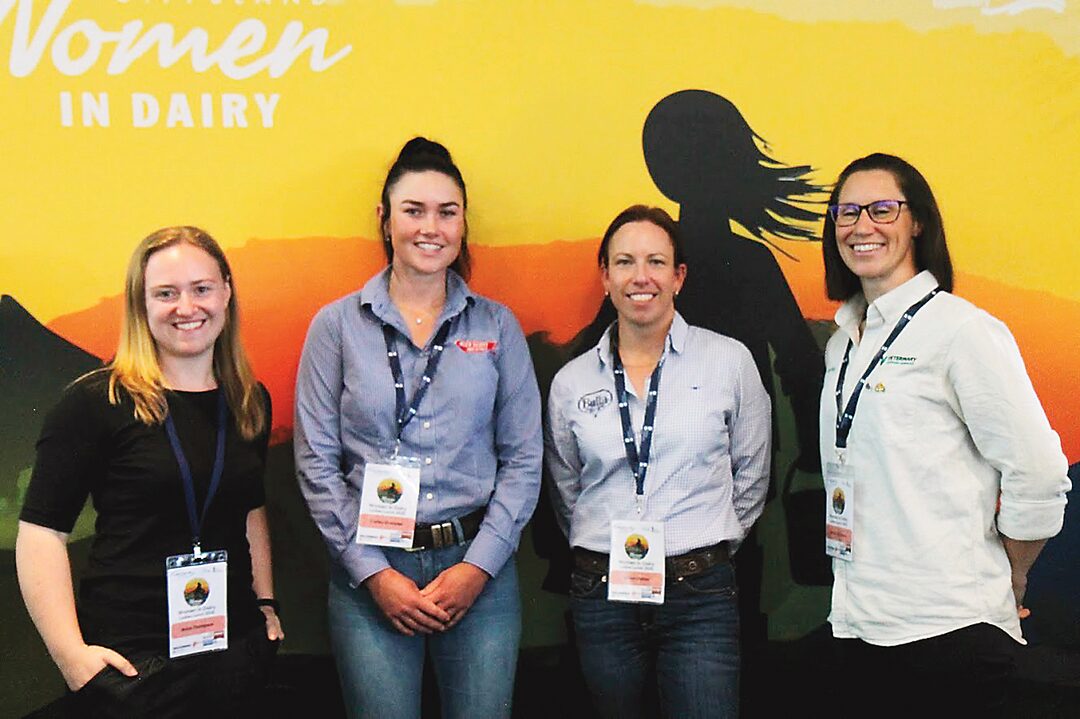
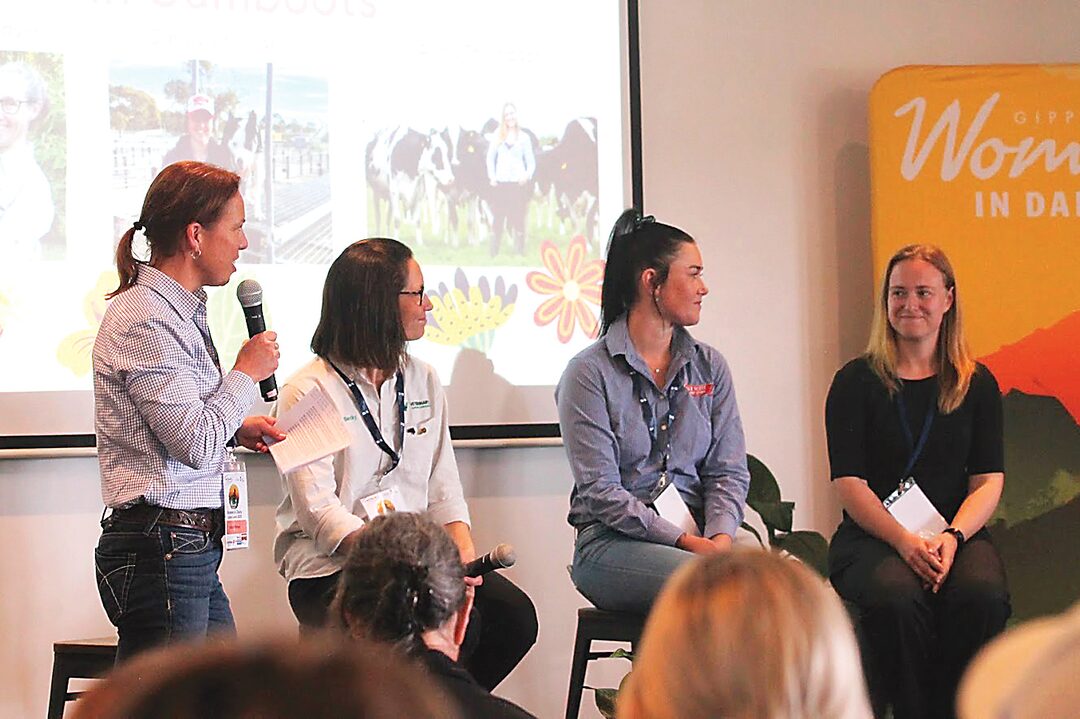
‘Trailblazers in gumboots; Women who drive change’ was the theme of the event, which featured a session led by MCE leadership facilitator and author Cynthia Mahoney; a panel led by WID co-founder Allison Potter, founder of Veterinary Support Services Becky Dickinson, Alex Scott salesperson Carley Einsiedel, and Senior Research Scientist Anna Thompson.
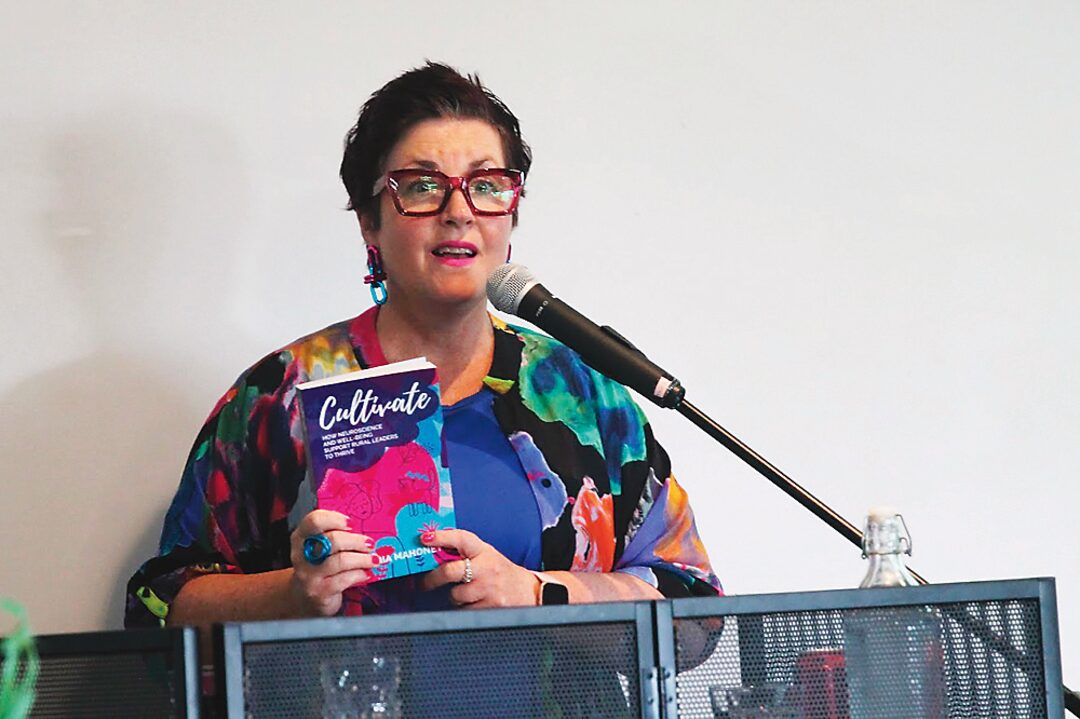
To launch the event, Ms Mahoney opened with a positive-mindset activity for attendees.
Ms Mahoney is a leadership facilitator who coaches, has written a book (before ChatGPT), and has worked in agricultural science, serving as a rural and network coordinator.
Previously, she worked with the Department of Agriculture for 17 years and left 14 years ago to start her own business.
Highlighting the importance of a positive mindset in dairy, Ms Mahoney noted that positivity from a managerial perspective extends throughout the production chain, leading to better outcomes.
“Evidence shows, all the neuroscience, all the science, shows that if we are happy and healthy, we perform at our best,” she said.
“For anyone who is managing employees or working in a team or leading people or even just leading yourself, it’s really important that you think about what makes them happy and healthy, and prioritise that. If you’ve got teams, think about what will make them happy and healthy, because then you’ll get more out of them.”
To make the event more interactive, Ms Mahoney led a positivity activity in which attendees spoke with people around them about something fun they had done that week, something they are grateful for, a woman who has inspired them, and why.
Confused by the activity, Ms Mahoney explained to the group that it is a “simple hack to use on your brain”.
“What you’ve just done then is you’ve changed the chemistry of your brain, and it’s like you’ve given it some fertiliser,” she explained.
“This powers you to feel better within yourself, and also, though, not only to change your own state, but also to affect the people around you.
“We notice threats, and we notice negative stuff, and so through our day, we experience the same amount of positive to negative emotions. However, because our brains are wired this way, we notice three times as many negative emotions as positive ones. That’s just what our brains program to focus on.
“If we can just be more conscious of what we’re paying attention to, we can change not only our experience of life, but because emotions are infectious, we can actually infect other people.”
With the room’s atmosphere now positive, Ms Mahoney highlighted the recent achievement of the panel facilitator, Allison Potter.
Striving for excellence, Gippsland’s Allison Potter, a beef farmer and former dairy farmer, head of farm services at Bulla Dairy Foods, and mother of three boys, has won the World Championship for one of her Speckle Park cows, where she travelled to Canada to pick up and celebrate the award.
Moving away from her achievement, Ms Potter introduced Ms Einsiedel, Ms Dickinson and Ms Thompson.
Carley Einsiedel
GROWING up, Carley Einsiedel was “hell bent” on being a jockey.
With a change in plans, she was fortunate to receive a Garden of Dairy Foundation Scholarship, which paved the way for her first career as an agronomist.
After additional study at the London Agricultural College, where she received a scholarship, she entered her career in agronomy.
After leaving her home in London, Carley spent two years as an agronomist and enjoyed her time on the farm.
“I really enjoyed getting out on farms alongside farmers,” she told the crowd.
“It was what I was passionate about at the time, but I did miss the livestock aspect.”
Two years ago, Carley was offered a position at Alex Scott as a stock agent, which she said was a massive change for her. Now, she has delved into auctioneering, which she said she never thought she would be confident enough to perform.
Stepping up to the mic for the first time was quite daunting.
Carley told the crowd that her first sale was at a clearing sale, where her boss determined she was ready after she shadowed her colleagues. Up she went, holding onto the railing. Halfway through, she called it quits.
“I was so nervous,” she said.
“I think I got halfway through the run and called it quits, thinking it was not for me. I got around the corner and thought, ‘come on, got to give this a go, got through the next run’.”
Reflecting on the challenges that led to where she is today, Carley noted that taking on a career as an agronomist and then a stock agent was one of the moments that put intense pressure on her, but it was undoubtedly for the better.
“I look back on that, and it now seems silly. I remember at the time that was a big step, certainly for the first time I auctioneered at a cattle sale, that was massive,” she told the group.
“Diamonds are made under pressure, so we gave it a go. It just kind of went on from there.”
Under pressure, negative self-talk can often build up. During the panel, Carley said that, in an industry all about connections, it was pretty easy to be down on herself, but continuing to stick with it has got her where she is today.
“My advice to my younger self would be not to be scared of failure,” she said.
“You find at the stage now where I’m expanding and hoping to start taking off clients, that’s a part of my job that I absolutely love, is getting on-farm alongside clients and getting to work with them and getting to work with them and their cattle and their operations.
“You work alongside your clients so much that you kind of adapt into their personal lives too. I think that’s pretty special, being able to get up and about every morning and do that.”
Becky Dickinson
ACROSS the other side of the career spectrum, Becky Dickinson saw herself in the music world, only to shift to a dream in veterinary sciences.
Encouraged to pursue her musical talents, Becky was told she wasn’t academically strong enough, prompting her to study music at university.
“I went to uni to study music, and very rapidly realised that everyone else around me there had a passion for this, that I love music, and I really still enjoy it, but this was that they were just something else, and I didn’t fit there,” she told the group.
“I looked back at being a vet, but at this point, I had done all the wrong subjects.”
Returning to university, she worked as a veterinary nurse for a year to improve her chances of admission.
Becky came from city life in the UK. During her music studies, she worked with a dairy farmer’s son, who invited Becky to visit his farm and interact with the cattle. This experience boosted her drive in the industry.
“I fell in love with being on the farm,” she said.
“I had a dream of being a cat and dog vet … I decided that I was going to come to Australia, where I landed my first job as a dairy vet down the road in Warragul.”
Now, 20 years later, she continues to work in Warragul but has “gone and done all sorts of things” and has maintained a mixed practice.
During the panel, Ms Potter highlighted the bravery each woman showed in getting where they were, even when they could have easily pivoted away from each challenge. To answer Ms Potter’s question, Becky replied by questioning whether it was really bravery or a lack of impulse control.
“I am the least brave person,” she said.
“I know what I am and what I do, I see myself as somebody with a lack of impulsivity control. I am very stubborn, and maybe that’s what led me to brave these decisions. So you might say brave, I might say sometimes quite impulsive?”
Looking back at her experience, Becky mentioned going back to get her degree would probably be the one that set things in motion the most.
With the motion on the way, so were the challenges.
During her residency, Becky injured her back, which she believed would end her career.
“I couldn’t really see how this pathway was going to go for me. How would I be able to continue my life doing what I had set out to do?
“I guess it was the stubbornness there to find pathways that I could remain a dairy vet, which would have to be modified. I couldn’t do the same work that I did before.”
Becky stepped back to be a mother of three boys, something seen as a “profession break” to help her find her next step and redirect her path.
After a few years away from veterinary medicine, she decided to return to dairy veterinary medicine, which she said was challenging with the children in tow on the mission to find a job.
“That was really hard,” she said.
“Having not done it for quite a while, and that was really hard with three kids, because I could not get a job, despite having lots of experience.
“This is where I decided to go into business: with zero business activity, knowledge, training, skills, anything as when … I think there’s a big gap that graduates are not supported well enough in large animal practices, which is why they don’t stay. It’s very intimidating, demanding work, and there is no support. So I thought, ‘Why not train graduates?’”
As the clinic took off, Becky was reached by a producer in South Gippsland who called to discuss the next step.
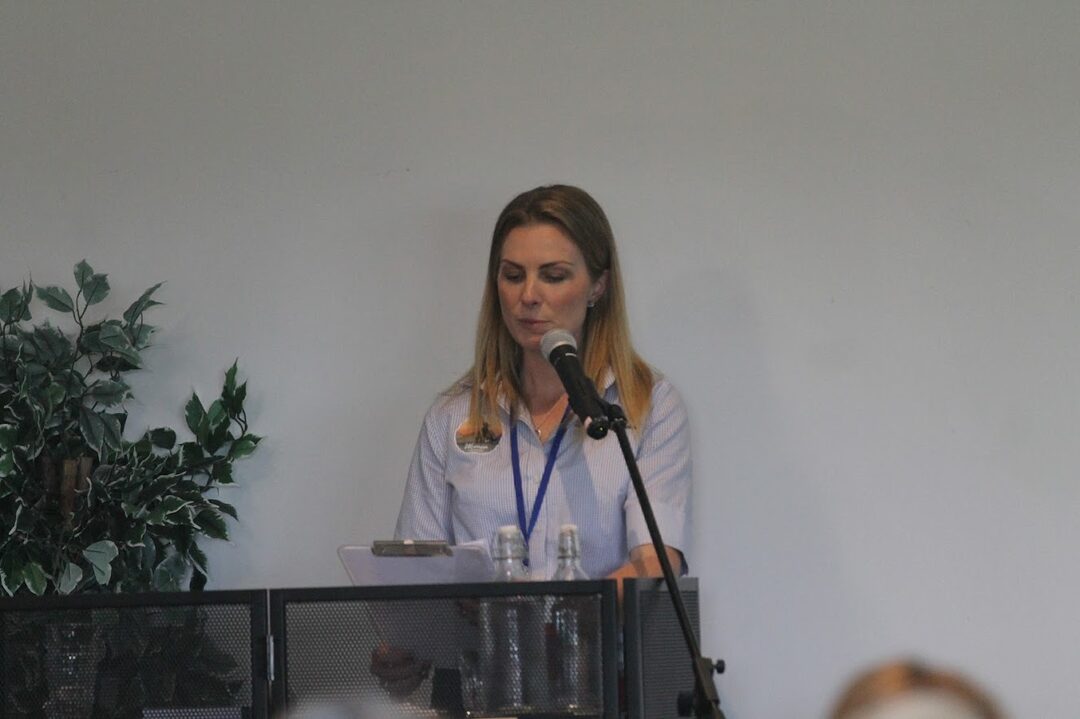
“He said, ‘I am on the federal compensation committee. We have a large fund, and we love what you are doing and we’re worried there’s not enough, and we agree that they’re not being supported and trained,” she said.
Providing ongoing support, the producer asked whether she could run her practice in Victoria and roll out larger projects.
Over the years, Becky told the audience that mental health has been a major factor and she has worked to address it through strategies and tools of how she sees herself, her confidence and trusting her gut instinct to know that she was heading in the right direction, as well as talking to others.
“I listen a lot to others. I love talking to people, but I love listening to people’s feedback and advice, hearing others and what they have to say as to where you fit somewhere, or how you’re doing something,” she said.
“People’s input helps me to shape and feel like I can find my own path.”
Anna Thompson
STARTING with on-farm experience on a nearby farm, Anna Thompson was introduced to the industry through a different channel.
While working on a small farm with pigs and sheep, her neighbouring farmers allowed her to sit in the shed with the animals.
As a small farm, Anna said she enjoyed the role despite limited work, and that her love for the industry began there.
“I carried on working in farms, particularly in dairy production,” she told the WID crowd.
“I was working as a candidate on a farm down the road from us.”
Unfortunately, when she applied to vet school, she was rejected.
“I didn’t get into vet school, but I decided to go do agriculture … I realised that I wanted to combine my love of farming and science as well,” she said.
“I’ve always been more drawn to the science subjects, and I realised during agricultural college that I really did love the agricultural science aspect.”
After she finished university, Anna worked at a research farm in the UK, which prompted her to pursue a PhD in agricultural science.
Anna later pursued her PhD, moving from the UK to Australia to find “something different”. Now, Anna has worked at the Ellinbank Research Farm for seven years.
Following Ms Potter’s discussion of pivotal moments and bravery, Anna noted that her decision to return for her PhD was one of many difficult choices. She said that during her PhD, it was quite challenging because she devoted three years to studying rather than working.
During that time, Anna lived on the farm and said she never really got away from it. She decided to pursue additional study time, which was challenging.
Another challenge that Anna highlighted was moving to Australia, not just because of the move, but in partnership.
“Having never visited before, my poor partner, who is still my partner now, we met three months before I was due to leave for Australia. And we thought, ‘oh, this isn’t going to work’, but bless him, he stayed the course and actually ended up moving here too,” she told attendees.
“I think coming here was probably the other big one, and maybe something just more recently, it kind of reached a point in my career where I was able to step up from being on a science team to leading my own science projects.”
Anna hopes that some of the projects she is currently working on have real-world impacts, and help producers make positive changes in their farming.