


By AIDAN KNIGHT
IN light of the recent capture and killing of Dezi Freeman, experts are warning the sovereign citizen agenda could make regional Victorian areas like Gippsland a hotspot for extremist ideology.
The sovereign citizen school of thought has been quietly gaining momentum for several years, and is often disguised or adjacent to the off-grid or ‘doomsday prepper’ communities.
Electoral authorities and security experts are warning that anti-government “sovereign citizen” ideology, which was once considered fringe, is increasingly organised, disruptive, and potentially dangerous, with regional communities considered vulnerable to its spread.
Experts suggest that regional areas, including parts of Gippsland and Victoria’s north-east, have become fertile ground for this ideology due to factors such as economic stress, isolation, and a sense of disconnection from, or distrust of, mainstream government authorities.
In the 2022 Narracan District State Election report to Parliament, there was a noticeable amount of votes collected reflecting sovereign citizen sentiment, with many who refused to vote on their ballot instead using the space to write the phrase “no candidate suitable to follow my will”.
Data provided within the report also shows conspiracy-style claims were more evident than in previous elections, often directly relating to Daniel Andrews and COVID-19 lockdowns, supporting the theory that the major event has created the surge of divergent thought.
This same event is also cited by multiple outlets to be the defining moment in Dezi Freeman himself becoming dangerous in his ideology, as he pursued an attempt to privately prosecute the former Victorian Premier in 2021, at which point several neighbours described him as radicalised in the anti-government agenda.
What sovereign citizens believe
SOVEREIGN citizens subscribe to a pseudo-legal, or “pseudo-law”, worldview that claims government laws, taxes, fines and regulations do not apply to them.
University of New South Wales (UNSW) academic and micronation expert Dr Harry Hobbs, who has been researching sovereign citizens and related movements for five years, said many adherents are not primarily driven by coherent legal theory but by an urgent desire to escape obligations they feel unable to meet.
“People who kind of believe the laws don’t apply to them, or don’t want the law to apply to them … are trying to look [for a] way to avoid obligations that they may have,” Dr Hobbs explained to the Express.
Residents of this pseudo-law mindset have appeared sporadically across Gippsland since the event of the COVID pandemic, the first of which saw a sovereign citizen pepper-sprayed and arrested at Bairnsdale after leading a violent anti-lockdown protest in September 2021.
The Express attended a community event titled ‘Save Our Farmers’, in July 2025, held at the Trafalgar Community Centre, which pushed sovereign citizen ideals to the combined Baw Baw and Latrobe residents attending.
Marketed as an anti-ESVF event, facilitated by several councillors of both municipalities, the narrative of the event was effectively hijacked by a man named Wade Northausen, who has been identified as a leader of a fringe group adjacent to sovereign citizens – something Mr Northausen rejected any affiliation with.
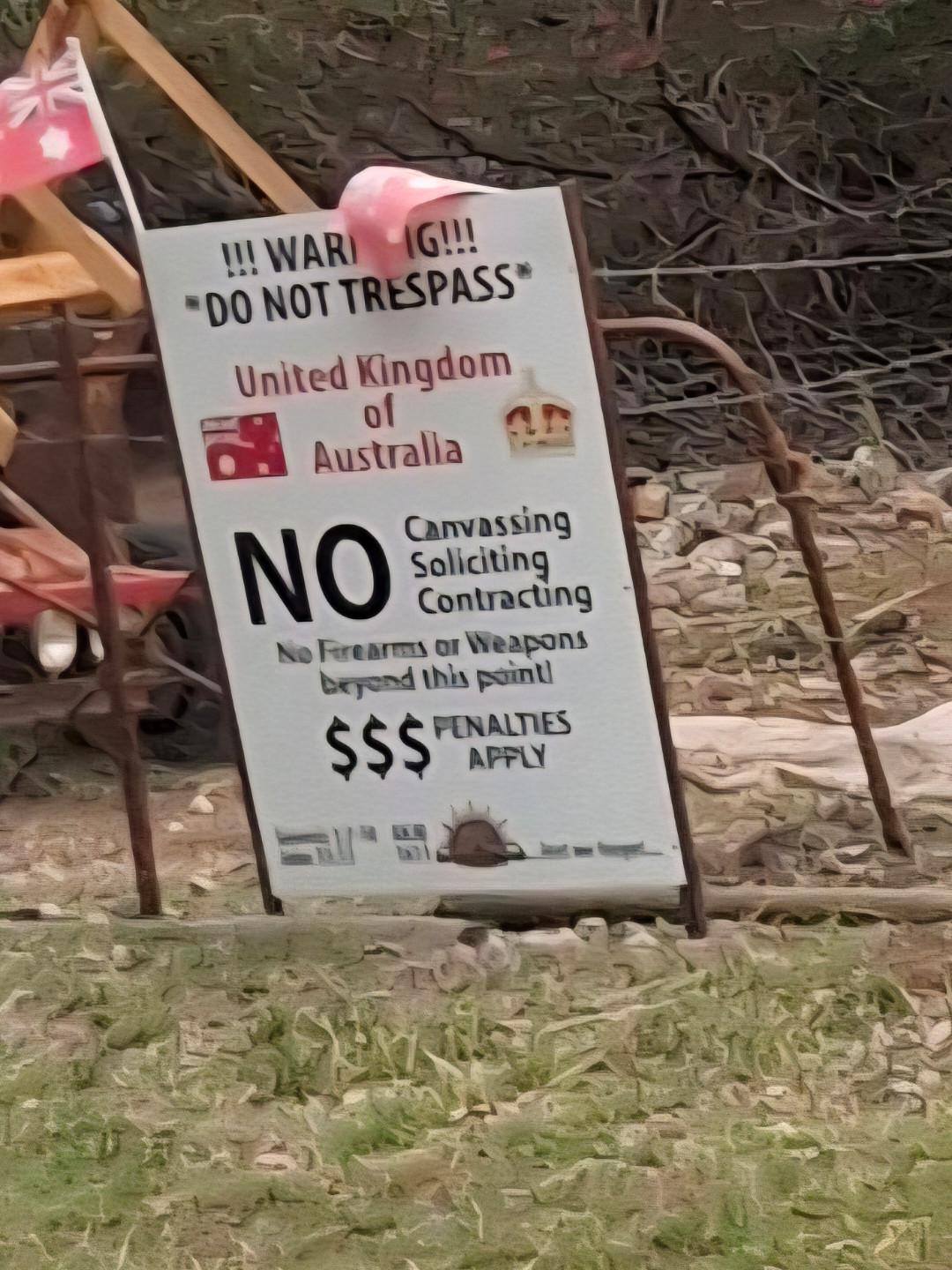
The Goulburn Valley local has spent his life on the road since 2022, living out of a branded bus, giving public talks for his group, the Billboard Battalion at town halls across the country and gaining a following online.
Instead of dialogue regarding the issue at hand, Mr Northausen spoke on “the COVID fraud” and how Victorian Premier Jacinta Allan operates her government under “instruction from Davos in Switzerland”. These baseless claims, which had nothing to do with councils decision whether or not to reject the fire levy, transformed within minutes to a narrative of “the who are terrorists who now own Australia”.
He also claimed the Australian Constitution does not exist, and that the federal government run a “depopulation agenda” which he claims they have been working on for 60 years, before launching into an anti-education spiel.
While the Express cannot characterise Mr Northausen as a sovereign citizen or not, his rhetoric and the themes raised during his address illustrate how sovereign citizen-adjacent narratives can be introduced into community settings, potentially creating pathways for individuals to be influenced by similar lines of thinking in regional areas.
His growing public profile within fringe activist spaces also highlights concerns raised by experts about how quickly such ideologies could spread if they were to gain broader traction in communities like Gippsland.
Dr Hobbs commented on the event and Mr Northausen’s rejection of the suggestion during media interviews that he is of or fosters sovereign citizen views, simply saying, “most people who kind of have the views don’t call themselves sovereign citizens. They obviously don’t call themselves pseudo-law adherents either, but instead use the same tactics or the same narrative.”
Dr Hobbs said in his professional opinion, Mr Northausen’s quotes would indicate an adherence to pseudo law, and that sovereign citizens operate under a ‘salad bar extremism’ model. This means while there is no clear-cut curriculum of sorts or membership model, those taking part in the ideals subscribe to what appeals to them within the alternative school of thought selectively. This makes it increasingly harder to define and collect data on an exact percentage of popularity.
Movements like sovereign citizens, QAnon, and other fringe conspiracies can overlap, share themes, and reinforce each other, even without formal organisational structures.
Not only do sovereign citizens and their ideology pose a threat to society in worst case scenario’s such as Freeman’s, they also clog up court systems.
“In the last year, they say that the numbers remain at an elevated level … compared to pre-pandemic levels. So it has risen – how much, it’s not clear – because we don’t know what the baseline was and it hasn’t come down to pre-pandemic levels. So it certainly is still more significant than it was previously,” Dr Hobbs said.
The term “sovereign citizen” is itself an oxymoron – one cannot be both sovereign and a citizen at the same time – a point often used by adherents to distance themselves from the label, even while embracing its core ideas.
Dr Hobbs said there is evidence the ideology is more common in regional communities than in major cities, as residents already feel cut off from institutions and services. For some, moving away from cities is part of the ideology itself.
“At one level, people … might move to a regional centre because they are trying to get away from the state, and then others who happen to already live in those centres might be attracted to this view because they feel that the state doesn’t provide for them,” he said.
Dr Hobbs said that despite the clear harms, regulating such speech is fraught, partly because it risks appearing to confirm adherents’ belief that the state is oppressive.
In October last year, there was a push for sovereign citizens to be registered as domestic terrorists after a Victorian man was ‘doxxed’ (had his personal details leaked online) after investigating the movement. He received death threats and was tracked by Sovereign Citizens whenever he left the house.
A declassified 2023 AFP report on the rising ideology summarised it as possessing “an underlying capacity to inspire violence”, like what took place last August in the Alpine region.
With nothing stopping a town hall meeting turning into an extremist gathering, its growing presence in regional areas raises a pressing question – how far will it extend if left unchecked?