


By STEFAN BRADLEY
COST-of-living relief, crime prevention, healthcare spending, 20 per cent off car registrations, half-price public transport and more construction and upgrades for schools, kindergartens and TAFEs.
The slogan for this year’s state budget is ‘Easier. Safer. More Affordable’.
Is this a boring budget or meeting the moment?
For better or for worse, the 2026-27 state budget does not rock the boat. And why should it? The state’s finances are not for journalists to write about, or for people to react to on social media.
Ideally, it tells us the direction the state government wants to take Victoria over the next few years, but it can also act as a manifesto for an election campaign.
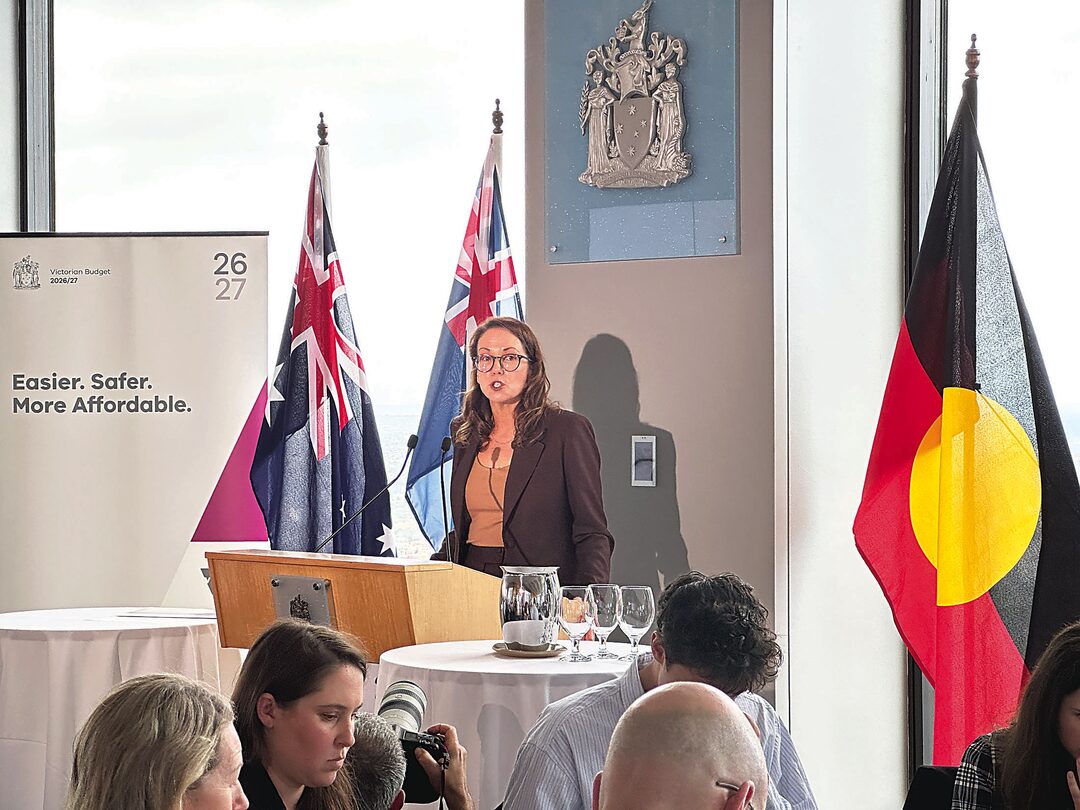
The 2026-27 state budget lock-up in Melbourne – attended by the Latrobe Valley Express and other media organisations – saw Treasurer Jaclyn Syme unveil her second and potentially final budget.
“For a long time in this country, there’s been this basic deal, that if you work hard, do the right thing, and look after your family, you’ll have the opportunity to build a decent life. But for too many Victorians, particularly families, that basic bargain no longer feels secure,” Ms Symes said.
“Not an easy life, not a perfect life, buy a decent one.”
Just like last year’s federal election and probably every election around the world in recent years, most governing parties have picked up that the only thing that truly matters right now is affordability and cost-of-living.
The budget contained no major announcements or so-called ‘election sweeteners’ – instead there are mostly smaller initiatives that we already knew in advance. The most surprising thing about this budget are these relatively muted measures, rather than big, bold calls that will change how Victorians live.
Ms Symes was asked by a reporter if the war on Iran prevented such election sweeteners.
“We we know that cost-of-living pressures has been was an issue for most Victorian families before the conflict, and we always said that this budget would have cost-of-living offerings. And I think you’ll see that from every treasurer, every state in the nation – it is what people are talking about. Things are tougher,” Ms Symes said.
“So yes, we always were considering what was the best mechanism, the transport and car registration initiatives. It goes without saying we’re influenced by recent events or by the war.”
That might be sugarcoating it a bit.
The budget papers do not merely mention the ‘Iran War’, ‘overseas events’ or ‘changing global market conditions’ (although ‘global uncertainty’ appeared); instead the budget pamphlet’s opening line is “Victorians are facing new cost of living challenges as Donald Trump’s war in the Middle East drives up fuel prices”.
The US President is named dropped a number of times in the papers.
Why do this? A poll published this month by The Australian Financial Review/Redbridge Group/Accent Research found 72 per cent of Australians disapprove of Trump.
One Nation leader Pauline Hanson scored a net approval rating of -1, with federal Liberal leader Angus Taylor and Nationals leader Matt Canavan both at -2, with Prime Minister Anthony Albanese at -9. Donald Trump’s rating was -58. The Victorian government might be betting that the US President’s unpopularity in Australia is an asset to their electoral fortunes.
To respond to the fuel uncertainty, as we already know, public transport is free for the rest of this month, and half-price from June until the end of the year. And from June 1, until July 31, eligible vehicle owners can apply for 20 per cent off their car registration.
An allocation of $1 billion will go to road repairs, with most of it going towards regional Victoria, yet the number of road resealing and pothole repairs will actually be going down.
The treasurer noted that many in her cabinet wanted more for their portfolios and that she had delivered a “disciplined budget”.
Regional healthcare will receive $75 million for the Regional Health Infrastructure Fund to renew and upgrade hospitals and health services across rural and regional areas.
The wages bill for public servants has gone up to more than $41 billion for 2026-27. Asked about this, the Treasurer pointed to recent efforts to hire more school teachers.
Leader of The Nationals and Shadow Minister for Regional Development and Liveability, Danny O’Brien, said the budget showed Labor has “lost touch with regional communities”.
“After 12 years of Labor, regional Victorians are still being asked to pay more while getting less,” Mr O’Brien said.
Deputy Leader of The Nationals and Shadow Minister for Agriculture, Emma Kealy, said cuts to agriculture were particularly concerning given the global economic uncertainty facing farmers.
“Farmers are on the frontline of global shocks – from rising fuel prices to supply chain disruptions – and this is the worst possible time to be cutting support,” Ms Kealy said.
“This budget cuts agriculture funding by 4.7 per cent when our farmers need more investment, not less.”
State debt will grow to $175.6 billion for 2026-27.
The government has talked about an operating surplus of $727 million for 2025-26 and $1.05 billion projected for 2026-27. But those figures don’t include capital spending, which includes infrastructure, which creates a forecast cash deficit of $7.7 billion in 2026-27, culminating to $8.07 billion in 2029-2030.
“The fact that we’re delivering services across the board is impressive given our structural disadvantage compared to the other states when it comes to revenue,” Ms Symes said.
“Despite persistent commentary asserting that we are the highest taxing state, the latest ABS data shows that Victoria collects less revenue per capita compared to every other state.”
The two previous state budgets under Ms Symes’ predecessor Tim Pallas (handed down in 2023 and 2024) attempted to rein in debt with spending cuts and taxes. Ms Syme’s first budget last year partly moved away from that, which this reporter believed was because an election was 18 months away, and the government was down in the polls.
“I want my first budget to give people hope,” Ms Symes said at the time, a contrast from the doom and gloom of the previous two budgets. She adopted the slogan, ‘Focused On What Matters Most’.
But in 2026, the election is mere months away and the government’s position in the polls has deteriorated further.
There are billions of unallocated funds that could be used for election announcements, so could we see something as major as the Suburban Rail Loop, which was unveiled for the 2018 election? Or does the state’s finances prevent something like that?