




By AIDAN KNIGHT
LAST Wednesday was one of radio silence for many across the Latrobe Valley and the rest of the country following the Telstra outage.
Regional Victoria was the hardest hit area by the sudden crisis.
The outage was first recorded at 4.30am on Wednesday, July 8.
Telstra is Australia’s largest mobile provider, with more than 22 million mobile services nationwide (although the company does not publish regional customer figures).
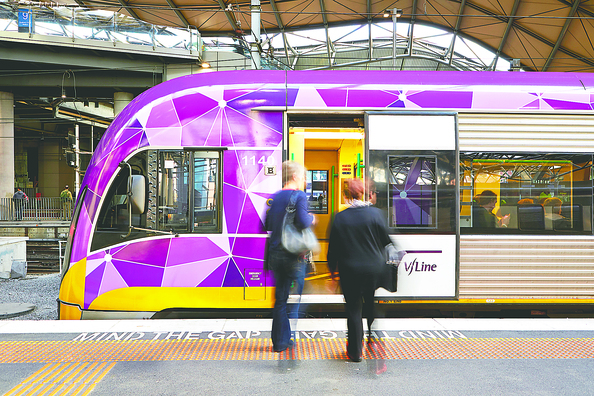
V/Line experienced a network-wide outage, as its signalling infrastructure runs on a Telstra 4G connection, and has for the past two years.
Metro trains run on with an internally managed communications line, with V/Line citing the more remote nature of regional travel making Telstra the best option (where Metro uses its own private towers instead), exempting them by large from experiencing a similar issue.
A vast majority of regional train control, passenger information screens, ticketing and security rely on Telstra.
During the outage, many devices displayed to their users they still maintained a valid 4G connection, but no data or calls were actually being received.
This prevented V/Line emergency phones from operating, as they will only operate when there is no connection detected (i.e. in reception blackspots or planned outages).
V/Line services in motion terminated at whichever was the closest station, and those along the Gippsland Line were initially told to “make your own way” to a metro station along the corridor to continue their journey if heading towards the city.
Local woman Wendy Farmer was travelling to a conference in Melbourne from Moe, and had to get a ride from Warragul to Pakenham (the closest metro stop) to make it to her destination – two hours late.
Perhaps the worst combination was for those commuting to work in Latrobe City from elsewhere in Gippsland, leaving regular V/Line customers unable to call or text their workplace to inform them of their tardiness.
Ms Farmer, ironically, was better off with the more outage-prone of the main Australian providers, as an Optus user.
Less fortunate commuters with a Telstra connection were left to their own (unconnected) devices, unable to even make use of the free Telstra payphone located at the station.
V/Line announced it would be halting all services across the network at 6.44am Wednesday morning. The first recorded replacement coach in the state arrived at 9.30am at Tarneit Station (Geelong/Warrnambool lines). These replacements were extremely limited, and not to be relied upon, as V/Line claimed that its coach services required a Telstra connection as well.
By Thursday afternoon, V/Line services had resumed across all lines after extensive testing of train radio communications.
Transport Victoria implemented a staged return to the normal timetable following the Telstra outage. However, authorities warned passengers to expect ongoing delays as services progressively returned to normal.
“It was really disappointing, because I’d left plenty of time to get to this conference and be there on time,” Ms Farmer told the Express.
“There were about 50 people stranded at Warragul, and they basically had to find their own way. A couple of people just said, ‘I’m going back home … I’m not going to work in the city today’.”
It seems there simply are not enough coaches in operation to adequately replace an entire regional rail network.
The Department of Transport was approached for comment, but did not reply by time of publication.
The only metro line that experienced any issues was the Stony Point line, but was rectified by 7.57am on the Wednesday of the outage.
The chaos from the outage wasn’t just limited to travel.
The telecom ombudsman collects data quarterly on complaints.
Last recorded quarter (January to March 2026), complaints regarding financial loss (excluding business loss) surged nationally by 32.7 per cent, with consumers frequently seeking compensation for lost work and missed appointments caused by network outages.
In outages like last Wednesday’s, consumers often seek compensation for lost work and missed appointments directly resulting from network outages.
In regional hubs like the Latrobe Valley, these challenges are often “amplified” because, unlike in major cities, residents frequently lack “alternative connectivity options” when a primary network fails. This lack of redundancy contributed to a 7.1 per cent rise in regional complaints earlier this year.
The quarter culminating in March listed Telstra as the nation’s most complained about provider, accounting for 33 per cent of the nation’s total – which is estimated to make up roughly 47 per cent of the domestic market as Australia’s most popular telecom.
The lack of connection saw the tables turn on the number one telco, after Telstra significantly benefited from the November 2023 Optus outage, which was ongoing for 14 hours, which experts deducted would bring a subsequent extra earnings of $125 million from returning customers in the coming years.
There has been no published data yet on any loss of customer base for Telstra following last week’s outage, but stocks dropped nearly three per cent on Wednesday, to a five-month low of $4.92.
Many elevators also cease to run during a Telstra outage, as most use the telecom’s services for its internal emergency phone systems. Commonwealth Bank Australia also reported that many merchants utilising EFTPOS through the company were unable to process transactions (which use a 4G network connection).
The Express took part in a media press conference with Telstra Chief Financial Officer Michael Ackland last Wednesday morning.
Mr Ackland confirmed that the issue was originating from a series of nodes within Telstra data centres, in both Melbourne and Sydney, which may provoke further public doubts into similar centres imminent for the Latrobe Valley and Morwell in particular.
The CFO told outlets that “just under 90 per cent” had been restored at 10am that morning. The fault itself was in the nodes ability to timekeep across the network.
“These nodes are not operating as expected, (…) other parts of the network can be affected, resulting in intermittent issues with some mobile calls and data sessions,” he said.
At the time of the address, many of these nodes had been restored, but Mr Ackland explained that it takes some time for their work to be reset “across all the thousands of servers across the network”.
Mr Ackland “did not want to speculate the V/Line outage”.
Telecom Ombudsman Cynthia Gebert added, “We know outages can have serious impacts, especially for people who rely on telecommunications services for their health and safety, and for small businesses that depend on staying connected”.
“Small businesses should keep records of any impacts on their operations. If you’re unable to resolve the issue with Telstra, contact the TIO; we’re free and here to help.”
It was confirmed at 12 noon by Federal Communications Minister Anika Wells, that some emergency calls were unable to be connected during the outage.
The next morning (Thursday, July 9), Telstra informed media that 90 per cent of Triple Zero calling errors had been reduced.
Telstra informed media by 10am Thursday that they continued to work on resolving a “secondary issue”, which was limited to emergency calls.
“The nature of this only became apparent as we resolved the original issue,” Telstra Senior Media & Issues Manager Janette Henstridge said, before the company reported it had been resolved at 2:35pm Thursday afternoon.
Meanwhile, V/Line experienced ongoing issues, actually advising all passengers to “defer travel”, rather than providing alternate options across the regional network.
Leader of the State Nationals and Member for Gippsland South, Danny O’Brien said locals deserved better public transport.
“Passengers heading to work, job interviews and family commitments were forced to either wait indefinitely or find their own way to Melbourne,” he said.
“While the disruption was triggered by a nationwide Telstra outage, it exposed the fragility of a regional rail network that Labor has neglected. Regional Victorians deserve better than being an afterthought. They deserve a government, and a rail network, that actually turns up.”
Dave Ryan, a reader and Traralgon local, jokingly commented on the Express Facebook page on Wednesday, saying “Definitely a good time to finish installing the Traralgon Bank Street traffic lights … make the best of a bad situation guys”, garnering several likes from like-minded residents.
Premier Jacinta Allan announced after travel resumed on Thursday that Victorian commuters would receive two full days of free travel as compensation for the delays, on the following Monday-Tuesday (earlier this week).
The Premier advocated for double the refund, stating the government’s position that “Telstra should match it dollar for dollar”, while also making it clear that “Victoria expects more than compensation”, demanding an overhaul and assurances that an outage of this effect will not be repeated.
The Express took part in the fourth Tesltra press conference, this time ran by chief executive Vicki Brady, returned from leave, who said,
“I’m the CEO, and so it absolutely starts with me, and that will be part of what will be considered once we get through and make sure we understand exactly what happened here and what changes might need to be made”.
At the press conference, Telstra stopped short of formally blaming “human error,” but Ms Brady did confirm that human work on the system coincided with the restart that triggered the outage.
“So while the human was working on it, it restarted”.
It’s times like these that make you glad for a physical newspaper.