


PHILIP HOPKINS
‘FROM paddock to plate’, a key agriculture policy goal, does not even begin to describe the ground-breaking private forestry business that is being developed at Yarram in South Gippsland.
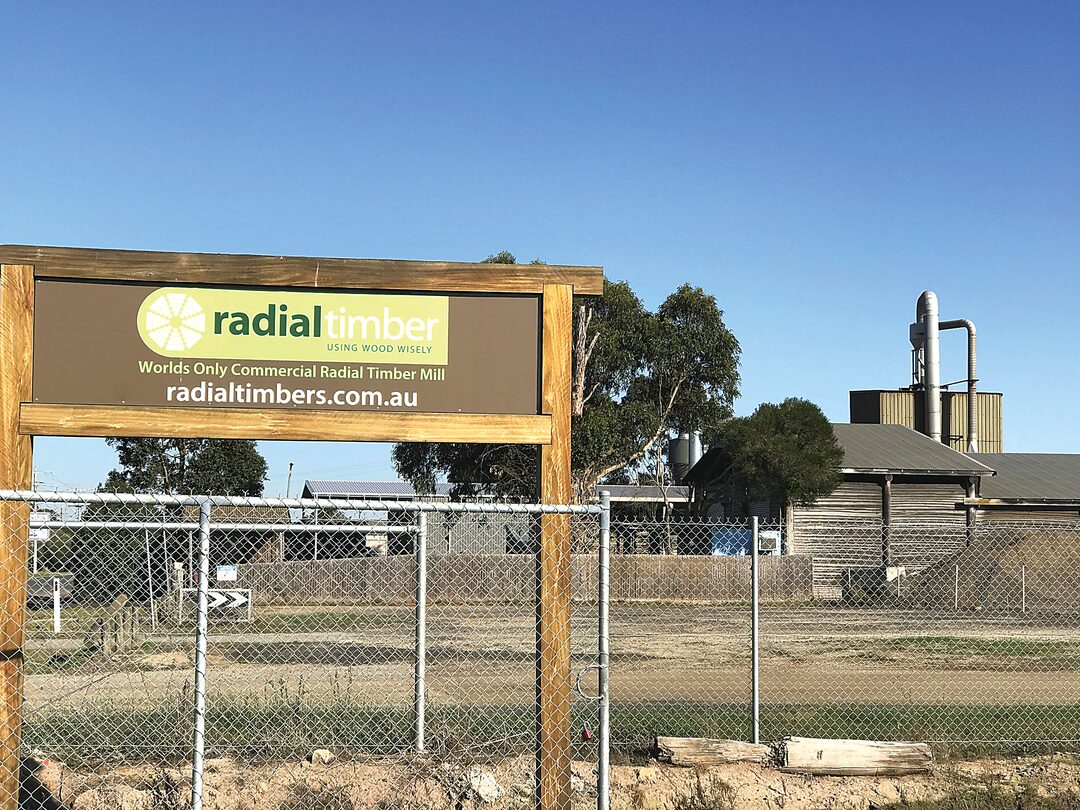
‘Paddock’ – a variety of plantation hardwood trees grown on local soil – is the basis of the partnership between the grower, Heartwood Plantations, and the processor, Radial Timber, whose ‘plate’ – an advanced manufacturing operation that is more than just a sawmill – is producing a variety of innovative products from engineered wood based on veneers to clean energy and fertiliser from a bio-energy plant.
These sit next to Radial’s green mill, firewood business and dry mill.
The partnership began more than 20 years ago when Radial Timber’s chief, Chris McEvoy, fearing that the native forest industry would end, teamed up with Heartwood’s Jon Lambert in 2004.
The vision: a 30-year plan to establish 2000 hectares of native Australian hardwood plantations on 25-year rotations to create a long-term, sustainable wood resource that would form part of the circular economy.
In the interim, Radial received native forest logs from VicForests while their hardwood plantations grew, but the Andrews government’s sudden decision to close the native forest industry in 2024 cut them off at the knees.
Rather than giving in, the companies hunted wood where they could get it.
“It was tough searching for wood, but in the longer term, if we could get through this bump, we will have wood in the ground,” said Jon.
Their progress in growing hardwood plantations and the development of the Radial plant was recently on display during a field day inspecting a plantation and the processing plant in Yarram attended by dozens of observers.
The inspection was of Radial’s Holman Plantation, a 78.6-hectare property just outside Yarram that was a former pine and blue gum plantation.
Bought by Radial in 2013 and planted to durable hardwoods in 2014, it now has a plantation area of 66.9ha.
Located on the foothills of the Strzelecki Ranges, the property has low fertility sandy soils and receives about 710 mm average rainfall, but since 2014 it’s been 606mm.
The companies’ policy has been to plant trees native to Gippsland; the Holman site was mainly established with Yellow Stringybark, Southern Mahogany and Spotted Gum, with some Red Ironbark and Coastal Grey Box.
“Radial is focussed on the outdoor market. The durable timbers here match those product requirements. There is no Mountain Ash or Shining Gum – they will not last more than five years; they start to decay,” Jon told the group of observers.
Of the four durability classes, Heartwood prefers the most durable, numbers 1 and 2.
“We focus on 1 and 2 for most of our work and trials. Eucalypts tends to be mixed; finding one size fits all does not work well with hardwood, even though blue gum is widely planted,” he said.
“With ‘eucs’, it’s more of a case of what species best suits the site. We look at aspect, rainfall, soils, the potential for frost and browsing by animals. We choose from four species and have started to get ‘more feel’ for which species likes different sites and soils.”
The pine and blue gum on the plantation were harvested and sold, and the first hardwoods planted. Jon said planting a second rotation, from pine to hardwood, they found the site needed some nutrition. There were deficiencies in copper, zinc, magnesium and iron.
“This is very sandy soil the further you get up the hill. Soil tests showed low nutrient levels, there was insect damage, some water logging and frost,” he said. This led to some replanting in 2015 and 2019.
“We have done a lot of micro fertilising from the air to the leaves. They have been treated; we are happy with the response and have resolved issues with insects, growth and the overall health of the site.”
Some species grown at Holman also grow in native forest, creating interesting comparisons between native forest and plantation.
“These (plantation) trees grow five-to-seven times faster. They are less dense,” Jon said, but it was too early to gauge any impact on durability, strength and colour.
Plantation and native forest samples have been planted at Innisfail in North Queensland, which has an accelerated environment for decay.
“We look at the progress of the different species to get a better understanding of how they perform. The results are mixed, but not to the point we would panic. We are dealing with early plantation wood; it’s not the same as we are used to. You need to use it differently. It’s a different material – that’s part of the learning curve.”
Plantation trees grow faster.
“First, you’re taking a seedling that’s been prepared, it’s got nutrients and has been well looked after in the nursery. It’s planted in nicely formed mounds. We aerate, mound the topsoil and get rid of weeds. We rip the soil to make sure it’s loose so the roots can really accelerate, protecting it from browsing. We’re planting at the perfect time right at start of spring – we give the trees every possibility of succeeding’ with eucalypts, if they start well, they grow quite rapidly,” Jon said.
“In contrast, native forest trees come from seed that’s dropped after a bit of disturbance, such as a fire. The ground could still be hard, some get browsed by wombats and wallabies and there is competition from other trees; here there is no competition.
“Plus genetics – we are doing a lot of genetics improvements as well. We source species seed from different parts of the state, grow them and get rid of crooked and slow-growing ones. We breed from seed – improving genetics to get trees that grow rapidly and are straight and of course have the wood quality.”
Since 2015, Heartwood has trialled growing two species together in each compartment.
“There is some natural competition, and we liked what biodiversity benefits it could bring, but the driving motivation was actually risk management. We have plantations in the Strzelecki Hills with high rainfall and we have them located on the flats. We have had massive losses on the flats in recent years due to frosts, despite long term records showing little frost in the area. We got three in one year,” he said, which wiped out several whole plantations.
“That’s been devastating.”
“On the flats, we have planted spotted gum, which is quite frost sensitive, but will cope with mild frosts if we get them away quickly.”
Jon said Heartwood was a genuine agroforestry company and runs livestock as well to help keep down undergrowth – particularly grass that grows in the gaps between trees and along the breaks. Bracken is more common on poorer soils and blackberries dominate the Strzelecki Hills.
“That is a challenge,” he said.
Getting on top of the fuel load is also crucial due to the threat of bushfire and to ensure “the neighbours don’t like us because we are growing lots of weeds”.
“It was a waste of money to spray or slash it, so we started grazing livestock, cattle for a while. It worked okay, but they are very fussy, don’t like eating the weeds and are heavy animals. We spend money on roads, they trample on the edge and damage the drainage,” said Jon.
Next cab on the rank was sheep.
“We’ve done a lot of breeding with sheep and now have a fantastic breed that works well in plantations, breeds well, is self-shedding and the meat is fantastic. There are now more than 1000 sheep on several properties that we run.”
An unexpected prize package was goats.
“In the hills, we have done a trial running goats for seven to eight years. That has challenges! But it has worked well on some blocks. It takes a far bit of effort and there is still work to do, but on some sites, blackberries are incredibly high, which even creates
problems to get in and do pruning.
“The goat is the only animal that neutralises the seed as they pass it and so they will go straight past the grass and go for the blackberries. I’ve seen them put their hooves against the tree and reach up as high as they can to get the blackberries, blood coming out of their mouths from the thorns.
“We are turning a waste problem into something productive, like meat. We have spent time developing markets, despite few abattoirs and sales being in Melbourne.”
Further protection comes from a waist-high fence around the plantations that aims to keep out wombats and wallabies whose foraging can damage or destroy seedlings and young trees. Jon said the fences often now have to be doubled in height: foraging deer and their ability to jump over the lower fence are the new menace to the plantation.
In planting, Heartwood starts with 1000 trees per ha, normally in four-to-five metre rows. The trees grow for four-to-five years, when 40 per cent of the trees are non-commercially taken out.
“These days with our equipment, we can do non-commercial thinning efficiently, then we start the pruning process, aiming for six-metre logs,” Jon said.
Thinning at 10-12 years produces the first commercial wood. Another 40 per cent of the trees, 30 per cent of the wood, comes from the site at this age.
“We get about 40 tonne of wood per ha, which is quite low but is reducing the cost – it’s not commercial, but it’s not non-commercial – it reduces our losses giving a better result than just cutting and leaving it on the ground. As we get more opportunities in the mill with bioenergy and firewood, the efficiency will improve and we’ll maybe break even with that thinning,” Jon said.
“One more thinning produces a few small logs, some veneer and firewood, but at age 20, we are left with 150 trees per ha on a site like this to grow the sawlog.”
Pruning, designed to produce knot-free wood, is an ongoing issue given its high cost.
“We argue, let’s try without it. You could potentially do that if you’re prepared to change your silviculture and if you have improved genetics. We don’t quite have that level of genetic improvement yet but with Yellow Stringy Bark and Spotted Gum there is potential. We could probably keep them at higher stocking for longer and forgo some diameter growth and not prune and maybe get away with it. Small branches are okay – will it work? This needs further work, we do not pretend we have it all sorted,” said Jon.
“The complexity of all this – you have to think in decades. You can write off a species at three years, and then in 10, it’s doing well. It’s the same with timber, you can’t put product straight to the market – it can degrade, there can be impacts from borers, it may have moved too much or faded. These are the difficulties that government does not understand in the switch from native forest to plantation resources.”
Developing the plantations is a constant process of trial and error where the conditions in various sections differ.
However, all species have grown at a similar rate on the Holman site.
Jon said average growth had ranged between 10 and 15 cubic metres per ha per year with average diameter breast height (DBHs) of 20-25cm at 10 years.
It’s all about looking to the future, said Jon.
“What will people want from forestry in 10-20 years’ time? That is our target now. Our industry has had a bad record in embracing change. In Scandinavia 20 years ago, they looked ahead, embracing technology and research to make it happen. They find a way, we don’t try until forced to. Now as a company, we look at what forestry should be and what people expect from it. We are heading in that direction.”
A big part of the Heartwood/Radial future is the increasingly sophisticated processing operation in Yarram.
The low value, thinned hardwood plantation logs find their home in Radial’s new LVL (Laminated Veneer Lumber) mill. Such timber would previously have gone to wood residues or firewood, but the LVL mill turns them into strong engineered wood products that can be used in construction.
Mr McEvoy said the small logs form a line that go through a peeler plant, which can peel a small log down to a 20-30mm core.
“This process has a 60 per cent recovery rate, unlike traditional sawlogs at 30-35 per cent,” he said.
The round log is peeled into veneer sheets, which are arranged in a parallel alignment, bonded together with adhesives and compressed under heat and pressure to form strong timber products – mass panels or other innovative products.
Spindle-less lathe technology’ is a new chapter in the growth of LVL, which up until now has used older, bigger sawlogs.
“We still have a lot of testing to do, including durability and weather performance, but this development is exciting: we can grow trees as a crop and turn them into engineered product in a third of the time it takes to grow saw logs for solid timber,” Chris said.
The LVL mill has a capacity of 20,000 m3 of plantation thinnings that can produce 10,000m3 of LVL annually after the final processing stage.
Operating in partnership with the LVL mill is the other half of Radial’s innovation drive: the bio-energy plant.
The plant harnesses the power of pyrolysis, a thermochemical process in which organic material, in this case hardwood residues, are heated at high temperatures without oxygen.
The heated hardwood does not combust but instead transforms into stable carbon. This process produces biochar, a stable solid that is rich in carbon that can fertilise and endure in soil for thousands of years.
“The plant can also produce heat and energy, and wood vinegar – a liquid, potentially usable in agriculture, also in cooking,” Chris said.
The $1 million pilot continuous biochar maker is the result of three years’ research and development and is a joint venture between Radial; Earth Systems, the technology provider based in Port Melbourne that provides the technology; and Spiegel Bioenergy, a South Gippsland battery supplier owned by John and Linda Ballis.
“We have a pure resource, most of the biochar plant around the world are working with waste, plastic waste, arboreous waste – green leaves, different species and densities; the product that comes out is not that uniform,” said Chris.
“Our timber is all dense class, one or two timbers, all exactly the same properties. It is uniform and produces a really high-value, consistent biochar product. We’ve got plenty of locally grown resources, forestry residue from our own plantations. The beauty of the continuous char maker is you can put through much larger volumes. Take the biochar and put it into degraded soils to improve it – I love this circular economy story.”
Chris said running on timber mill waste, the bio-energy plant can:
Produce heat for the mill’s kilns and for heating LVL logs;
Produce energy to run different parts of the mill;
Produce biochar to go back into degraded plantation soils;
Produce wood vinegars for use as natural herbicide in the plantation, and;
Utilise waste product, reducing the mill’s footprint.
Chris said current potential of the pilot plant is to produce an additional 75 kilowatts of electrical output per hour to be used mainly for internal use.
“A bigger scale plant is currently being installed which will triple capacity,” he said.
A capacity of 5000m3 of wood residue produces 2500 tonnes of biochar.
The future of the operation will depend on how the plantations roll out: Radial has 800 ha planted with another 1200 ha to plant over the next 10 years to become fully self-sufficient on a 30-year rotation.