


FOOTBALL
By LIAM DURKIN
THIS year marks 30 years since the Fitzroy Football Club ceased to exist in the AFL.
While the merger with the Brisbane Lions has given fans a club to barrack for, as well as five premierships, the story of the Roys’ final days still cuts deep.
Fitzroy has a number of connections to the Latrobe Valley, most notably through champion Traralgon footballer Bernie Quinlan.
Quilan played 189 games and kicked 576 goals for the Lions, winning both the Brownlow and two Coleman medals after crossing from Footscray.
According to local legend, he once kicked a torpedo from the Traralgon Recreation Reserve oval that sailed over the railway line and bounced into Victory Park – quite fitting for the man known as ‘Superboot’.
Quinlan returned home last season for a Traralgon Football-Netball Club reunion, and also opened the Traralgon Bunnings in 2012.
Other prominent Fitzroy players from the Valley included cult hero Darren ‘Doc’ Wheildon (Newborough), and Morwell’s Paul Abbott, who finished his career with the Lions after winning flags at Hawthorn.
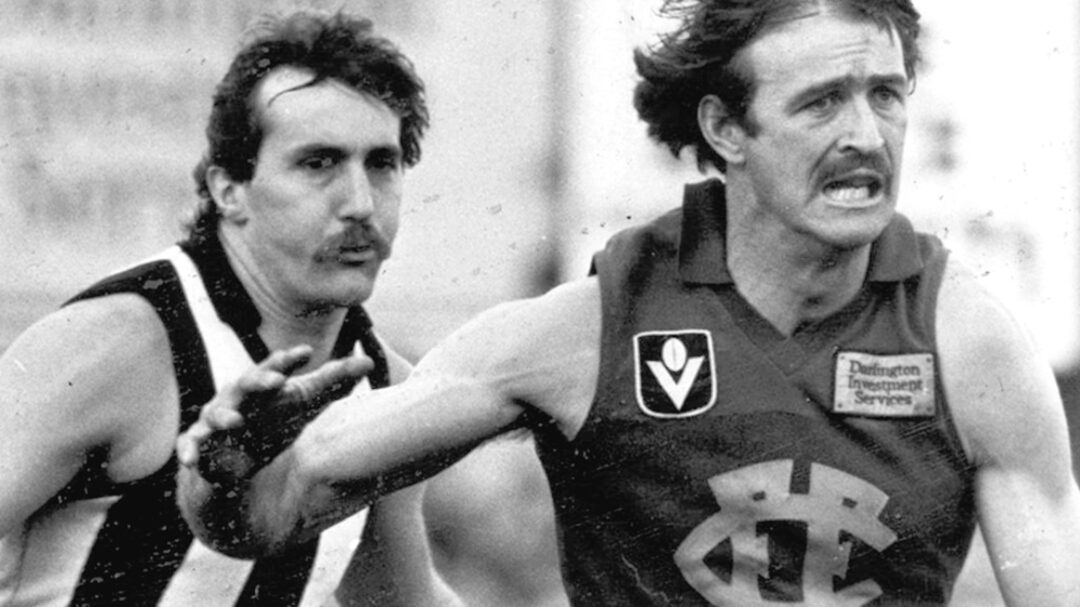
Quinlan also coached Fitzroy in its second-last AFL season in 1995, the same year Footscray legend Doug Hawkins donned the maroon, blue and gold for one final hurrah.
Hawkins, who last year named Quinlan’s ex-Bulldogs teammate Kelvin Templeton as the greatest player he ever saw, said Quinlan should never have been sacked.
The man who pulled the trigger was Fitzroy president Dyson Hore-Lacy.
Hore-Lacy, a Melbourne barrister, perhaps epitomised the true effect of Fitzroy’s final days. According to numerous sources, he still can’t bear to talk about it – quite telling given what he would have encountered during his career in the courtroom.
Much has been written about Fitzroy’s demise, and while the club was always teetering on the brink due to finances, in this writer’s view, there is little doubt the AFL killed off the club.
It’s a view shared by Moe netball A Grade premiership coach, Peter Moody, who was recruited to Fitzroy in the days of under 19s footy.
He gets emotional when talking about Fitzroy, especially given his whole family followed the team.
“It cuts me and my family to the bone. Since they merged, there’s not one member of our family that still follows the Lions,” he said in a 2020 podcast with the author.
“My mum couldn’t even go and watch them play the last time in Melbourne, it was so hurtful for her. She was the whole reason our whole family barracked for Fitzroy, she was the one who instilled the love of footy in me and my brothers.
“It was (a) pretty traumatic time for Fitzroy around late 80s, early 90s. They (other clubs) were taking all our players, anyone who was any good just got ripped out of the team and sent somewhere else.”
When asked about the AFL having blood on its hands for what happened to Fitzroy, Moody responded with “absolutely”.
“We believe the AFL let Fitzroy wither and die, let all the other clubs come in and just basically pick off all the decent players (so) that they were so bad in the end, they had no choice but to fold,” he said.
“It’s completely different today. I think after they saw how Fitzroy died and what it did to a lot of the supporters, that it was in their best interest, at the very least, to relocate clubs rather than just let them fold.
“A lot of Brisbane Lions fans will argue they didn’t fold, they merged – it’s not the way I see it. A lot of Fitzroy fans, and good luck to them, they’ve watched them play and win premierships, but for me it was never going to be the same, it was just the Brisbane footy club with a Lions logo on it.”
Moody switched to St Kilda when the Lions went north.
Former Express editor and Fitzroy supporter Gregor Mactaggart also laments what happened. Despite adopting the Brisbane Lions as his club, he said the premierships of the early 2000s didn’t feel like Fitzroy flags.
Above all, what happened to Fitzroy is largely a cautionary tale to other AFL clubs in the cutthroat business world of professional sport.
As was accurately said in the brilliant William Westerman book Merger: The Fitzroy Lions and the Tragedy of 1996, the Roys, to their detriment, never went from being anything more than a suburban football club.
Their ultimate demise was therefore not entirely surprising, but no less wretched.
Someone with an intimate knowledge of Fitzroy was Leon Wiegard.
Wiegard was club president in 1986 when things were at its craziest – a season that saw the side one game from a Grand Final, but also, seemingly dealing with a new merger partner every week.
Express reporter Liam Durkin tracked Wiegard down some years ago, and put together the following interview.
LD: It’s still painful for the Fitzroy diehards. What is it like as an ex-president of the club? Do you miss it? Is there a hole in your heart?
LW: While I’m a life member of Brisbane Lions it’s certainly not the same as the passion for Fitzroy. After Fitzroy merged it’s not like barracking for your son anymore, it’s like barracking for your cousins son. I have come to the realisation that everyone did their best to stay in Melbourne, but in the end ‘you can’t beat city hall’.
LD: Can you tell us a little bit about your history with the club?
LW: All four Wiegard boys supported Collingwood until we were about five, six, seven and eight when our father, a keen Fitzroy man, originally from Bendigo, told us we had Form 4s to fill out, meaning we were tied to Fitzroy – all BS of course but we fell for it – three of us finished up playing for the under 19s (under 1944 premiership player Gracie Fields then Len Smith). Older brother Keith went on to play 30 odd senior games before being injured. Keith and I both became presidents of the club.
LD: Fitzroy always seemed to be up against it even going back as far as the 1950s. Was there a contributing factor as to why the club struggled?
LW: Fitzroy was the dominant team in the early days of the league. I don’t think the club recovered as well as some others after World War 2 but it did have some really good teams in the late 1950s and certainly in the 1980s.
LD: Despite all the off field drama things slowly started to turn around in the late 1970s and the team played finals regularly throughout the 1980s. Was there a main reason for the turnaround?
LW: We had the dual advantages of good recruitment with Bernie Quinlan, Higgins from Geelong, Len Thompson and Max Richardson from Collingwood, Robbie Walls from the Blues etc. And the wave of new players coming from all over the place: Garry Wilson, Ron Alexander, David McMahon, Laurie Serafini and the like. There was also the vital recruitment from Templestowe/Doncaster area of Gary Pert, Paul Roos, Richard Osborne and Grant Laurie, possibly the best influx to the club ever. Getting Robbie Walls and then David Parkin to coach was a major reason.
LD: 1983 was probably the year when Fitzroy had its best chance to play in a Grand Final and maybe even pinch the flag?
LW: We were the best team in the comp and there were some that would say that Bernie took an unpaid mark in the goal square late in the last quarter of a final that would have won it and progressed us further. (Although I still jokingly blame Glen James, the umpire, who is a good friend of mine).
LD: There was of course that famous one point elimination final win in 1986 over Essendon. Can you tell us about that day?
LW: I was high in the stand at Waverly that wet Saturday with John Dawson, a banker and lifelong Fitzroy man who later joined the board. Leon Harris to Micky Conlan and we were in direct line as he kicked it from an angle. We were never going to win that one. It was one of the most exhilarating moments I have ever had in footy.
LD: Fitzroy did win a premiership under your leadership, it happened to be a reserve grade premiership in 1989 which featured Newborough’s Doc Wheildon. To do that in front of 100,000 people must have been a highlight?
LW: When the boys went the heavy in the last quarter I thought they’d all be reported – some were! Great win under Robert Shaw.
LD: While all the on field stuff was playing out there was just as much action happening off the field as the VFL expanded to a national competition and a number of Melbourne-based clubs were put under pressure to merge or risk going out of business. That must have been a hectic period?
LW: For that reason and as the AFL director at the time I made sure I was on every subcommittee. It took a lot of my time away from the family but it was meant to make sure that we knew what was happening.
LD: My understanding is in 1986 you called on the players to vote on whether they wanted to relocate to Brisbane and the players unanimously said yes. Is that true?
LW: My memory is that they decided that whatever the board decided that they wanted to stay together as a team. It was terrific to see such regard for each other.
LD: So why did it fall through?
LW: The offer made just did not stack up. Look at the fortune that the likes of Paul Cronin, Christopher Skase, Ruben Pelliman lost, a lot more, many times over than the AFL offered us at the time.
LD: Did a lot of clubs get into financial trouble simply because their supporters didn’t grasp the concept of the importance of buying a membership?
LW: That was part of it – but the position the Commission took (looking for a victim) and certain sections of the media did not help.
LD: It must be one of the great ironies that Fitzroy was considered too powerful to be given draft concessions in the early 1990s?
LW: Maybe address that to the AFL who had new ‘children’ on the block that apparently needed assistance.
LD: The club’s last game in Melbourne ended up being something of a public death. Did you have many emotions that day as the theme song was played and people streamed onto the MCG for one last time?
LW: I do recall that and I was there. All the past players went onto the ground. I was asked but felt it was a players thing. Very sad day.
LD: Then the following week the club went to Perth to play their last ever game in what was something they were totally undeserving of. Did you make the trip over?
LW: No, I did not think it appropriate.
LD: Were you onside when the Lions eventually went north to Brisbane?
LW: To be honest I looked around but kept coming back to the Lions. I have good friends at the other clubs and go to whatever games I’m invited to but it was and is always the Lions.
LD: Do the Brisbane Lions premierships of 2001-03 carry much meaning for you?
LW: My word, I sat near Kevin Murray on each occasion and was delighted at each win, twice as much when I saw how much it meant to him.
LD: Fitzroy isn’t exactly entirely gone, as they still compete in the VAFA and play at the Brunswick St Oval. It must be great to see the maroon and blue and FFC monogram still playing on a football field in Melbourne?
LW: I live not too far away and should get down there more I guess. I have spoken there a couple of times. They do a great job with the juniors and keep the colours flying.