


STAFF WRITERS
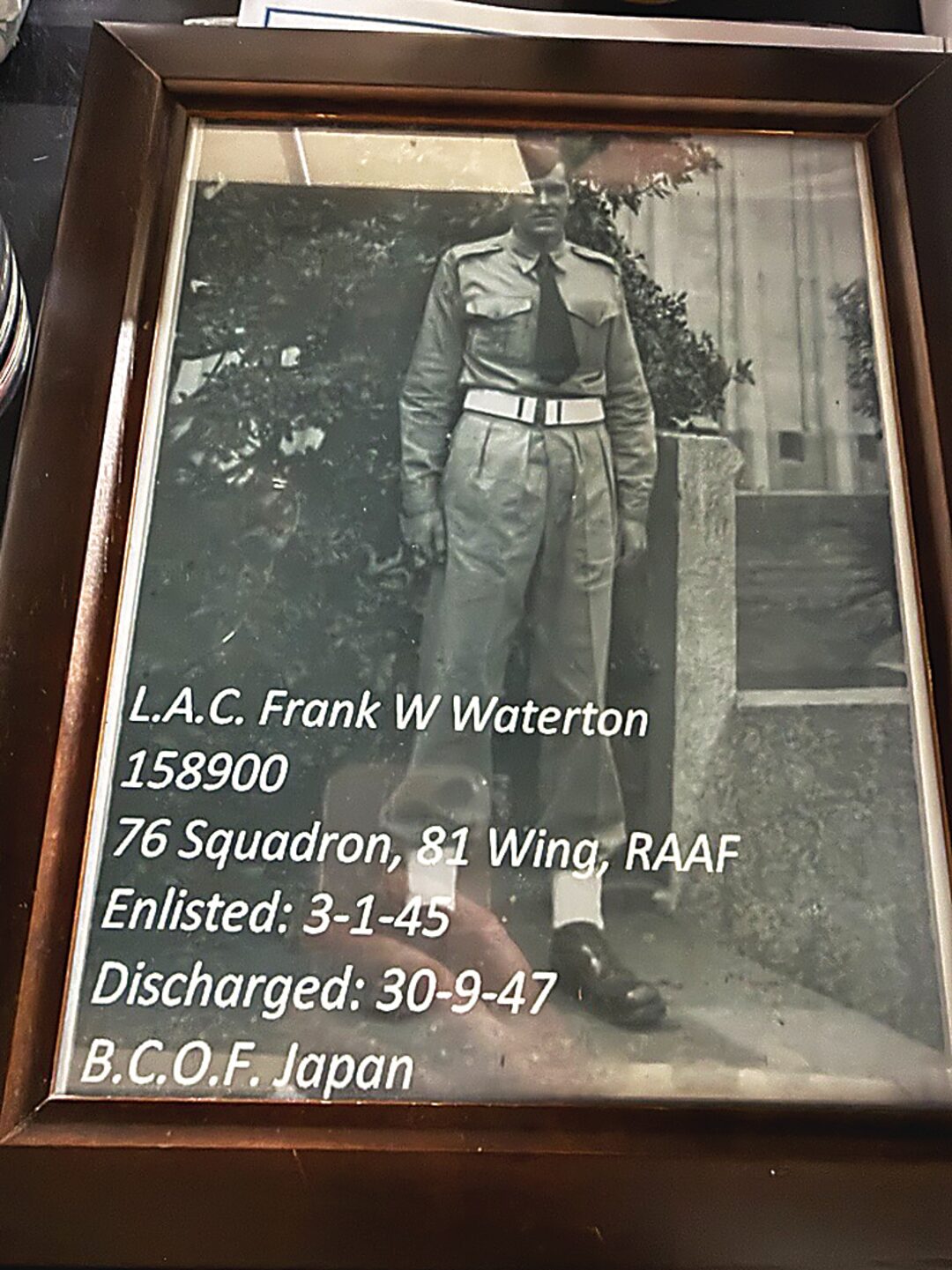
FRANK Waterton joined the Air Training Corps six weeks before turning 18, and went on to serve with the Royal Australian Air Force as ground crew.
Now aged 99, he is one of the less than 1000 Australian World War 2 veterans still living.
He has strong connection to the Trafalgar-Thorpdale RSL Sub-Branch, where he remains a well-respected and active figure.
The RSL, for Mr Waterton, is not simply a building – it is a place where memory gathers, and where it is kept alive.
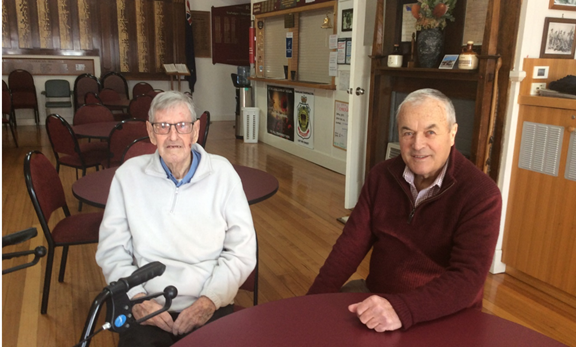
Friends from the local sub-branch, including president, Jim Crowe, and welfare officer, Leonie Gracie, still visit him regularly at his home in Mercy Place Lynbrook.
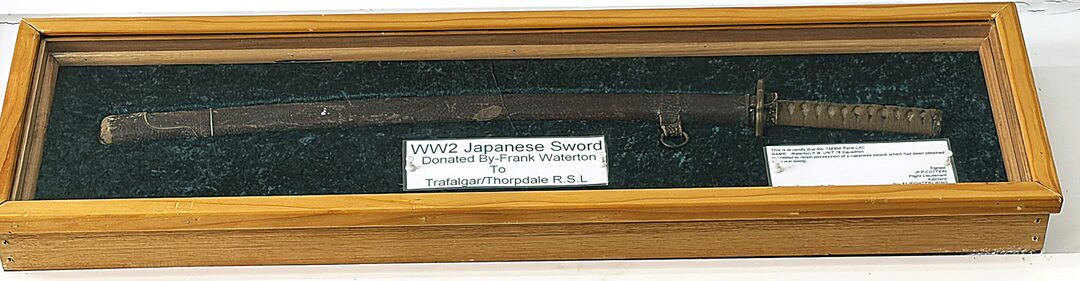
During Mr Waterton’s stationing in Japan during WW2, he came in possession of a Japanese sword, believed to be ceremonially used by Japanese officials.
Mr Waterton donated that sword to the Trafalgar-Thorpdale RSL and it now sits up high and mighty on the wall.
“He found it in the rubbish tip and he said ‘oh I’ll grab that’,” Mr Crowe said.
Though they can’t pinpoint exactly what year the sword was donated, Mr Crowe said it was a “long time ago.”
Anzac Day is a “special” day for Mr Waterton.
“I used to spend it down at the Trafalgar-Thorpdale RSL near where I used to live,” he said.
“Anzac Day means a great deal to me because it’s a time to stop and remember the people who never came home. I had two uncles Francis and William who died in WW1. As the years go by, there are fewer of us left, but you never forget those mates, or the family, who gave everything. When The Last Post plays and the wreath is laid, it brings it all back.
“To me, Anzac Day is about making sure their sacrifice is never forgotten, because the life we have today came at a great cost for so many.
“A day to remember my uncles who served in WW1 and the sacrifices of the men and women who served in WW2 and other conflicts.
“I have a quote that I wrote down that sums it all up: when you go home, tell them of us and say, for your tomorrow we gave our today.”
On his war service, Mr Waterton had hoped, as many young men did, to take to the skies (specifically as a Lancaster bomber pilot).
Instead, he remained firmly on the ground as a youngster in the unit, servicing aircraft, cleaning guns, and readying bombs and rockets for missions flown by others.
When Germany and Japan surrendered, Mr Waterton chose not to hang up the uniform. He boarded the troopship Duntroon and made the long, uncomfortable journey north, via New Guinea and Guam, through storms, illness (including a gastro outbreak that forced the ship to turn back to New Guinea) over a month. Stationed in Japan with the 71 Fighter Wing and 76 Squadron, Mr Waterton lived and worked out of former Japanese facilities for almost two years.
“I signed up six weeks before my 18th birthday, as it was inevitable at that time that the papers would arrive for your service when you turned 18,” he said.
“I ended up enlisting on the third of January 1945 and served with 76 Squadron, 81 Wing of the Royal Australian Air Force.
“After the war, I was sent with the British Commonwealth Occupation Force to Japan, where I remained until my discharge in September 1947.
“When I enlisted, I asked if I could fly the Lancaster bombers, but instead because I was still so young, they kept us teenagers as part of the ground crew which involved servicing aircraft, cleaning guns, and readying bombs and rockets for missions flown by others.
“After the war ended, I decided I wanted to be part of the occupying forces rather than going home, and I was sent to Japan.
“I still remember the journey over. It took four weeks to get over there, rather than the two weeks to get back! It wasn’t a straightforward trip. We stopped in New Guinea because there was an outbreak of gastro on board the ship, which caused a fair bit of concern among the leaders and delayed us for some time. Once that was under control, we pushed on to Guam.
“At Guam, there were American troops preparing to move out, but before long, a big storm came through. We headed back out to sea and spent three days riding it out in the Pacific. It was rough going.
“When the storm finally settled, we returned to Guam, restocked our supplies, and then set off again for Japan. By that stage, we’d been travelling for about three weeks.
“We eventually made our way into the Inland Sea and arrived at Kure in Hiroshima, which was the headquarters of the British Commonwealth Occupation Force.
“From there, we travelled by train further south to join 76 Squadron. It was a proud unit with a strong history in the Royal Australian Air Force. I spent close to two years in Japan.
“During that time, I was also attached to the Royal Air Force on special duties for a period of three months, which was a unique experience. I remember my first winter there very clearly – it was the first time I’d ever seen snow, and it was quite a shock. “The occupation force was made up of troops from Australia, Britain, New Zealand and India, and we were responsible for the southern part of Japan.
“There was a real sense of camaraderie between us – the Anzac spirit was strong, even so far from home. Anzac Day was always significant. We held large parades, including one in Tokyo, and also back at base on the parade ground.
“Those moments meant a great deal to all of us. The British Commonwealth Occupation Force was commanded by an Australian, which made us proud. It was an important time in my life – challenging, at times uncertain, but something I’ve always remembered with a great deal of respect and pride.”