



By KATRINA BRANDON
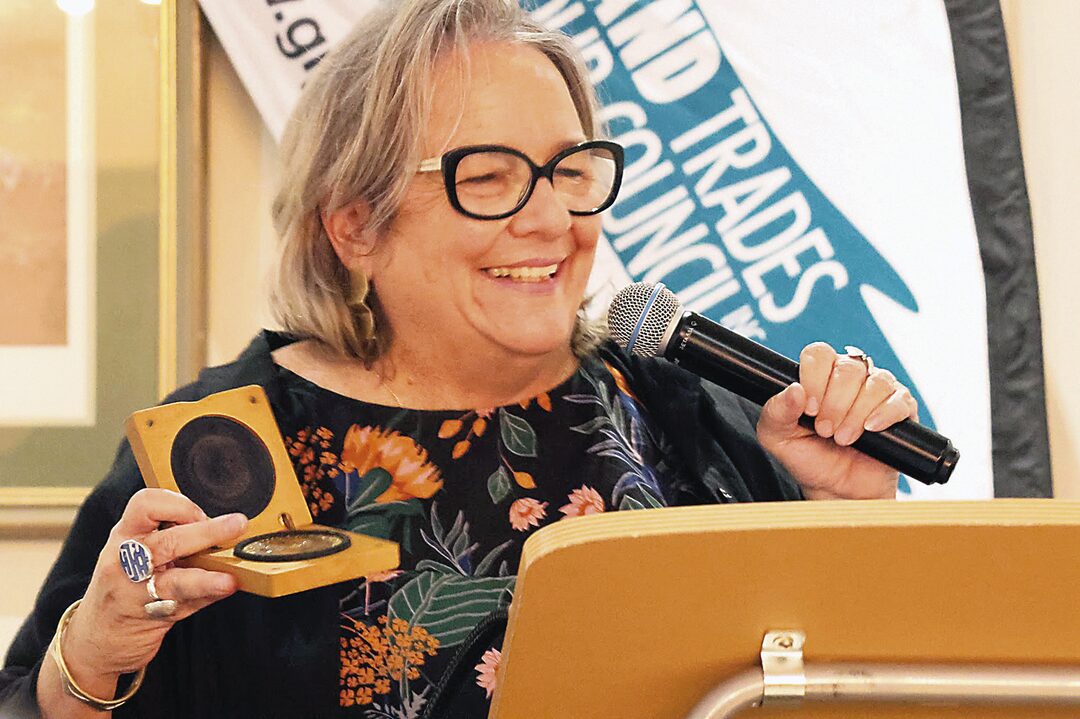
THE 2017 Nobel Peace Prize, won by the International Campaign to Abolish Nuclear Weapons (ICAN), was front and centre at the Gippsland Trades and Labour Council’s May Day dinner earlier this month.
ICAN was the first Australian founded organisation to win a Nobel Prize.
The 18-karat Fairmined green gold, plated with 24-karat gold, was awarded to the group for its efforts to achieve a treaty-based prohibition of nuclear weapons.
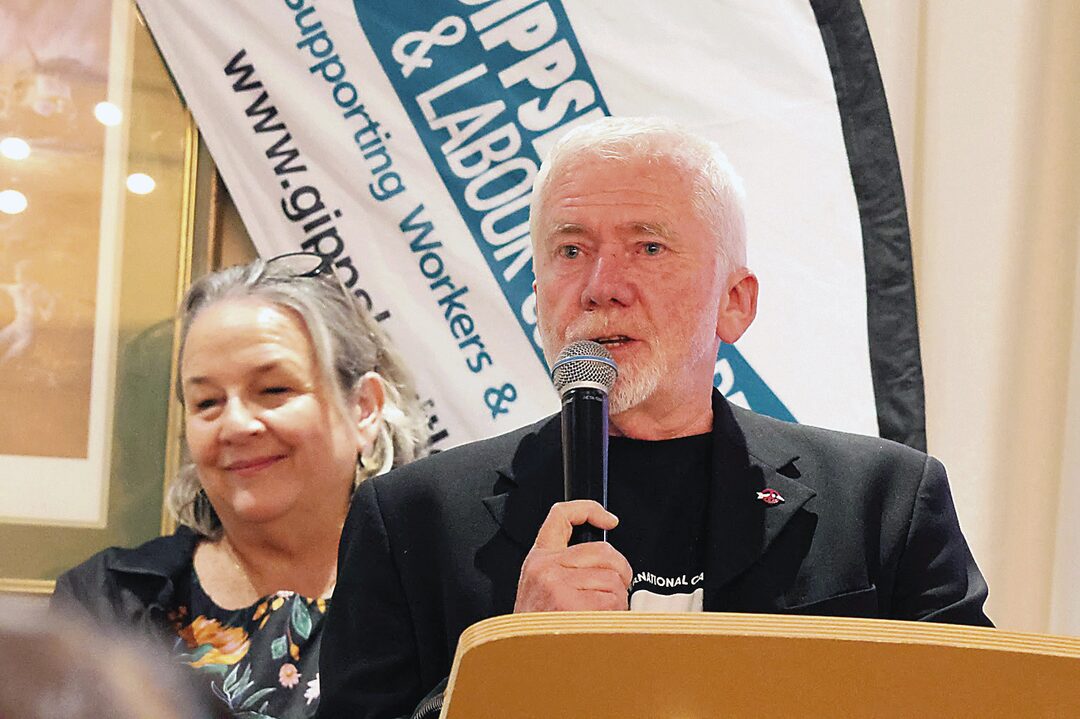
Representing the organisation was Dimity (Dimi) Hawkins and Dave Sweeney AM.
A crowd of about 140 people heard from the pair at the local May Day dinner held at Morwell RSL.
Ms Hawkins touched on ICAN’s story.
“Nuclear weapons are here in Australia. Australians have always pushed back on nuclear weapons as some of the worst aspects of war. The people of Australia and the Pacific have seen the impact and lived the legacy. So I believe it’s not only our right but our responsibility to take us to a global level,” she said.
“This is why we began ICAN, here in Australia. Twenty years ago, a small handful of us based in Melbourne, frustrated … what progress was not happening in nuclear disarmament and how it had been stored globally, took what many thought of as a pretty audacious move to kickstart ICAN, the international campaign to abolish nuclear weapons.”
“We know what these weapons do when they’re blown up in the atmosphere or dropped from planes or exploded from rooms or set off in oceans, deserts, in the hulls of ships, in the basements of buildings, under the Earth’s crust.”
Ms Hawkins said that testing of nuclear weapons in the Pacific has taken effect, with the Marshall Islands taking the brunt of the tests.
According to Ms Hawkins, between 1945 and 1996, more than 2000 nuclear weapon tests took place around the world, and 350 of those were in the Pacific region.
In Australia, the British tested 12 nuclear weapons between 1952 and ’57, where they also conducted hundreds of nuclear weapons testing and development trials, leaving a huge legacy of radiological contamination.
“In 2017, 122 countries and the United Nations were brought to the peace table to negotiate a treaty on the prohibition of nuclear weapons,” Ms Hawkins said.
“They didn’t come to this on their own. They were led there by their keepers. This is the power of our voices.
“The Treaty of Prohibition of Nuclear Weapons now has 74 states parties, as well as 25 extra signatories, just half of the world’s governments. Sadly, and to the great frustration of many of us, our government is not one of them. With over 12,187 dead warheads in the arsenals of just nine countries today. The vast majority are under the control of two men, Putin and Trump. You’d have to ask why.”
Ms Hawkins highlighted that collaboration and communication helps bring peace to the table.
Mr Sweeney said decisive action needed to take place.
“Right now, we are opening the door, and there is a really significant chance of an escalation of nuclear weapons being housed or hosted or using our seas and our skies for the AUKUS,” he told the group.
“AUKUS in itself is about nuclear power, and that is okay with this treaty. This treaty is about nuclear weapons.
“We take some comfort from statements from the Prime Minister … that Australia does not see a role and will not support nuclear weapons, but they are not the statements of our AUKUS partners.”
In February this year, there was an end to the New START (Strategic Arms Reduction Treaty), which was the last piece of significant legislation hanging over from the Cold War that constrained nuclear weapons deployment between Russia and the US, which has more than 90 per cent of nuclear weapons.
Vladimir Putin wants an extension, while Donald Trump says a new treaty should include China.
“Now, that means, when they come to Australia in the future, they could be carrying nuclear weapons,” Mr Sweeney said.
“That makes Australia an enabler of nuclear weapons. It makes Australia a target. It makes our country a place that launches nuclear weapons. Now we say that it is absolutely critical to draw a line in the sand, to put a red line that Australia will stand up for itself and fight for itself, by not using (or hosting) nuclear weapons.”
With nuclear power a topic during last year’s federal election, Mr Sweeney said that while nuclear power can be debated, there should be no debate on nuclear weapons.
“Nuclear weapons are instruments of mass destruction. They are illegal, they are immoral,” he said.
“We’re a good country. We should draw a line, and we should stand with the heart of the nations in the world that have signed this treaty.”