



By BLAKE METCALF-HOLT
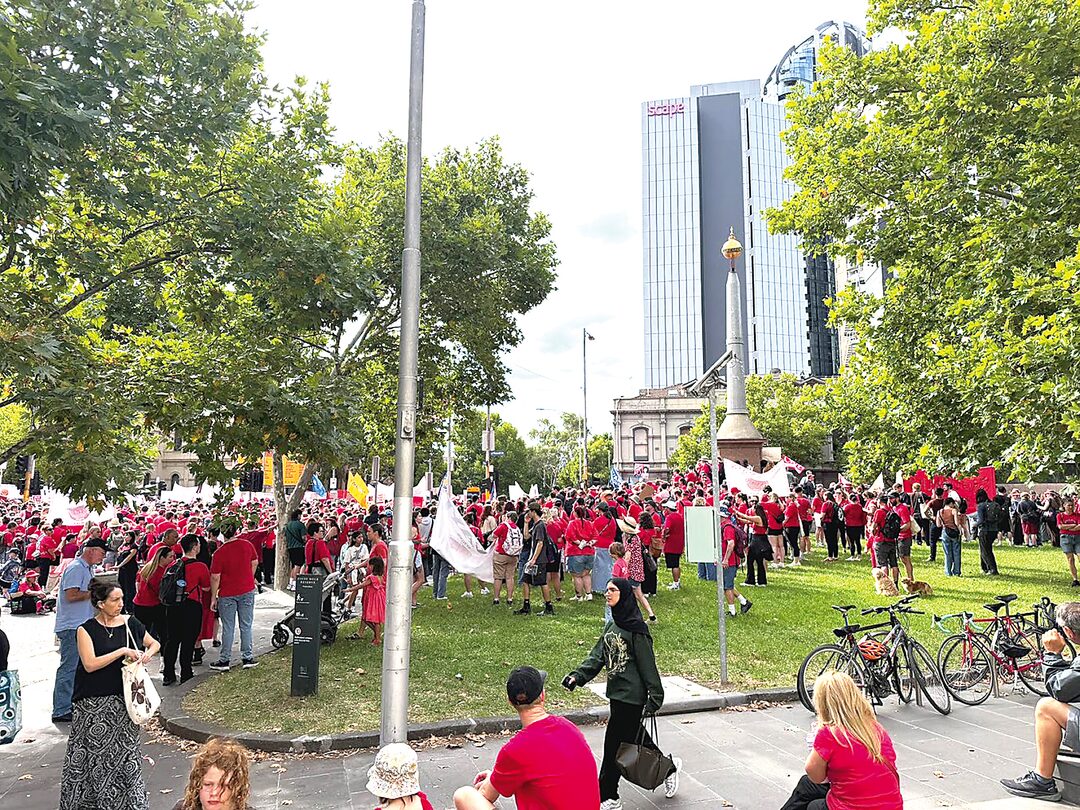
VICTORIAN public schools were again left at a standstill to start the week, as teachers and education staff weighed up a new pay offer from the state government.
A third strike was ultimately scrapped after the Australian Education Union (AEU) revealed on Monday (August 17) that a member vote had come back in favour of the latest proposal from the Carroll Labor government making Victorian educators the highest paid in the country.
Tabled on August 10, AEU members were given a week to make a decision, coming back with an overwhelming response of 79 per cent in favour.
AEU Victorian Branch President Justin Mullaly congratulated all members for their fight, which began with initial industrial action in March, before a second was held last month.
“Well done to every AEU member for the pressure you put on the government,” he said via social media.
“Well done for taking stop work action, for implementing bans and limitations, for engaging your colleagues and parents in the broader community in which you work.
“Together we’ve been able to get a significant outcome that delivers real pay increases, real improvements to conditions and we got a commitment from the state government to deliver full funding for our schools.”
The state government’s offer maintained a pay rise between 28 and 32 per cent dependant on the educator’s role, while adding a $2000 lump-sum payment for all if an agreement was met.
Also included is a limit on the number of face-to-face teaching hours, the time spent attending meetings reduced by one hour, and a one per cent annual lump payment for the top earners only.
The Express spoke to multiple people from local schools during the week of the member vote, and while many believed it to be an unsatisfactory offer, a deal was expected to be reached.
Despite the agreed deal still falling short of the AEU’s initial ask of a 35 per cent pay rise, much opposition still centres on not adequately addressing issues of workplace conditions.
The slashed face-to-face hours carried over from the previous rejected offer, with many education staff say they continue to feel unprotected by the state government bodies when incidents occur in the classroom.
“Our biggest issue is we have zero offers of any help with violence and behaviour in school,” a local union rep told the Express.
“What they (Department of Education) currently make everyone do is every time there’s an incident, any form of violence of behaviour, we have to write a report and that goes to the department and that’s it. We get no help.”
A suggestion was made for the Department of Education to employ allied health professionals to monitor schools and support staff dealing with repeat high offenders.
The union rep also said that despite the pay rise, by the time other industrial action takes place in other states, they will be right back at the bottom.
It was also pointed out by many that the initial $2000 lump payment does not affect education support staff, such as teacher’s aides and administrative officers, due to it going on a pro-rata basis.
While working during school hours, which covers a 0.8 workload to be considered full time (standard 38-hour working week), it falls short considering what teachers’ weekly working hours are.
As such, education support staff will likely not receive this payment in full, if at all, while they also don’t go near the annual lump, solely for those in the top pay grade.
Two people working for local schools even went as far as to call the lump payment a bribe by the state government to get the dispute resolved.
“A lump sum is not a pay rise, neither is an allowance, which there are a few of those mentioned throughout the process,” one said.
“The amount of tax we will get on it is wild, so it’s not actually $2k in people’s pocket.”
The state government’s first offer earlier in the year included a commuted work allowance, which has been removed in the subsequent proposals.
A resolution needed to come, with fears that a change of government at the upcoming state election would force negotiations to start all over.
The previous state government offer in late July came close to being accepted, with 51.18 per cent of union members rejecting it against 48.82 per cent being for.
THE decision on whether to accept or reject took up all of last week, perhaps ignoring some of the education workers’ largest concerns, but followed Premier Ben Carroll somewhat addressing the need for improved workplace conditions.
On August 9, the Premier spruiked that the Victorian government was working towards fulfilling the obligations for fair funding of the state’s public schools before the November election.
Mr Carroll told the ABC that he had engaged in conversation with Prime Minister Anthony Albanese on multiple occasions in recent weeks about the plans.
“My priority is delivering full and fair funding for our public school kids,” he said.
“Two reasons. Thirty per cent of our disadvantaged kids are in public schools, it’s twice what it is for the non-government sector. I want to make sure that we reach up and bring every one of those kids for their future.
“Secondly, it is the right thing to do.”
According to a Legislative Council Legal and Social Issues Committee report in May, Victoria has the lowest funded state school system in the country.
Mirroring the Gonski Review of 2012, which identified the significant social disadvantage of Australian students’ education outcomes and the need for an equitable school funding system, Victoria joined the federal government’s public school funding agreement in January 2025.
All states and territories are now signed on, with Victoria needing to increase its funding in the sector to 75 per cent so it is federally matched and can meet the Better and Fairer Schools agreement.
The Full and Fair Funding Agreement increases the contribution from the federal government to 25 per cent of the Schooling Resource Standard, which would push state schools along to eventually be 100 per cent funded over the agreement’s life, which ceases by 2034.
The outdated nature of current school infrastructure in Gippsland is apparent, especially in the Latrobe Valley.
The latest reports (December 2025) from the Victorian School Building Authority recognised that 17 of 27 schools listed in Latrobe City were below standard condition.
Three were deemed to be in poor condition, even lower than the 14 schools in the ‘worn condition’ category.
Lowanna College, Newborough was listed with the worst score for Latrobe City at a 2.92, followed by Traralgon College (3.06) and Elizabeth Street Primary School, Moe (3.19).
Elizabeth Street was the recipient of $5.2 million upgrade to help modernise the Moe school, while Traralgon College had upgrades undertaken on both campuses completed in 2023.
Alternatively, Latrobe Special Developmental School, Traralgon was the best rated at 3.87, followed by Churchill primary schools, Churchill and Churchill North (3.68 and 3.67), and Yallourn North Primary School (3.64).
In the 2026/27 state budget, school enrolment-based funding received a $43.2m increase, while $52.1m was allocated for school upgrades, to be increased to $116.4m in 2027/28.
Of the 51 capital works projects announced in the state budget, both small and large scale, none were for Latrobe Valley schools.
Mr Carroll served as Education Minister from October 2023 until he toppled former Premier Jacinta Allan last month.