


By PHILIP HOPKINS
IN an economic and reputational boost to the Latrobe Valley, Latrobe Magnesium is set to receive large funding from the US as part of the $8.5 billion US-Australia critical minerals deal.
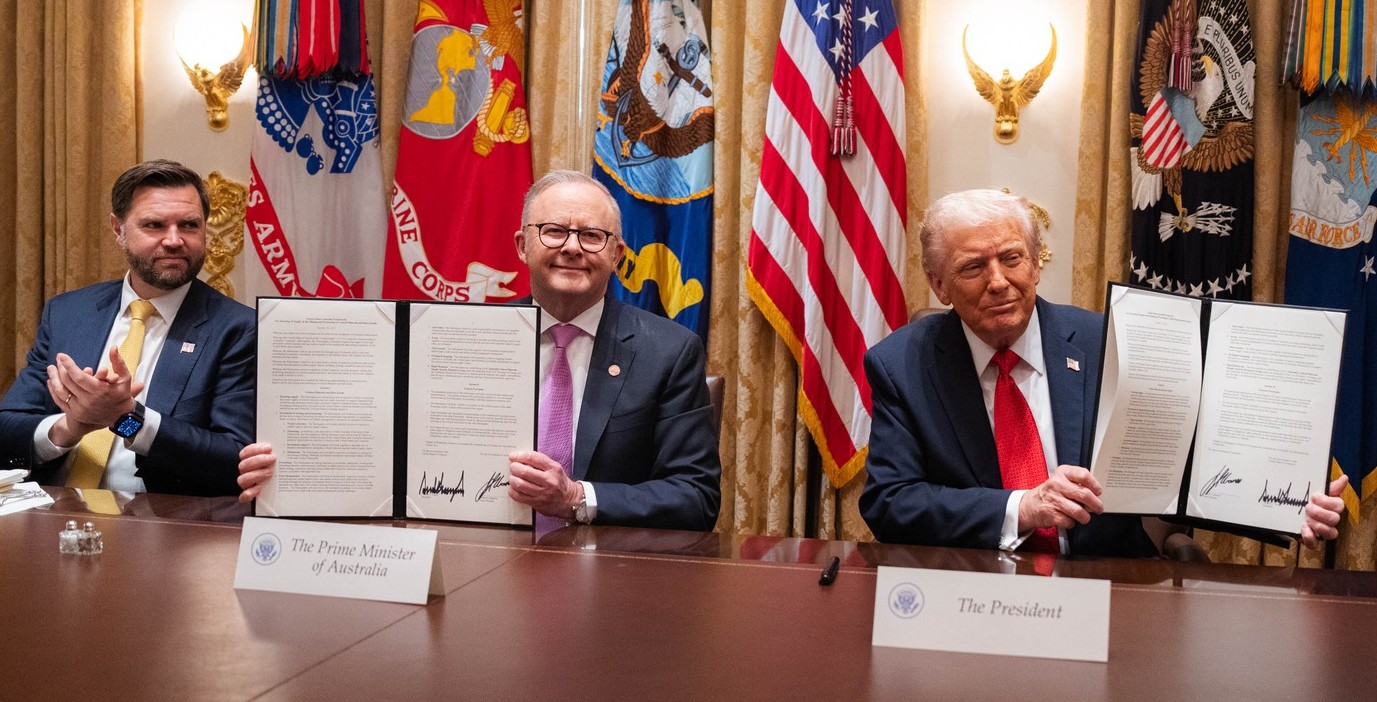
The agreement was signed in October in a meeting between US President Donald Trump and Australia’s Prime Minister, Anthony Albanese. Latrobe Magnesium, based in Morwell, has developed technology that can produce magnesium from the ash waste produced by Yallourn power station.
Latrobe was one of seven ASX-listed critical minerals companies to receive backing from the US Export-Import Bank (EXIM).
Latrobe received a letter of interest (LOI) from EXIM for up to $US122 million (AUD $187 million) to finance the construction of its 10,000 tonne per annum commercial magnesium plant in the Latrobe Valley, with a repayment period of 15 years. The LOI is non-binding – it does not represent a financing commitment – until EXIM conducts its standard due diligence.
Latrobe Magnesium’s technology has the potential to turn millions of tonnes of ash into a massive resource of critical minerals, which are deemed essential for modern technology, energy, and defence. Re-using the waste, ash avoids costly underground exploration and the building of mine infrastructure, as well as putting waste product to productive use.
“Magnesium is critical because about 90 per cent comes from China, and a few per cent comes from Russia,” Latrobe’s chief executive, David Paterson, told the Australian Financial Review. “So you can understand why the rest of the world is looking for a western producer of magnesium.” nMagnesium is used to make steel stronger, as well as in the production of titanium and aluminium. The metal is vital to the manufacture of electric vehicles, as well as military hardware such as aircraft and ships. Fighter aircraft use magnesium flares to lure away enemy missiles.
Mr Paterson said the US interest was a short-term bonus, but the company’s selling points had been around for years. Latrobe’s technology was developed in-house in collaboration with Wollongong University and the CSIRO.
“We have been developing for 20 years, but now everyone is starting to understand the mentality of the magnesium metal,” he said.
Latrobe’s technology converts fly ash into magnesium oxide by extracting unburnt minerals such as carbon and silicon. The remaining magnesium oxide is then turned into a metal ingot. It currently runs a demonstration plant at Hazelwood North and recently raised $10 million to complete the 1000-tonne-a-year plant. The project was funded through a $4 million fundraising at 2.3 cents per share, and another $6 million from institutions.
“We call it a demonstration plant, but it’s basically a small commercial plant. We have spent $70 million on it, and we’re probably going to spend another $10 million,” Mr Paterson told the AFR.
Production of magnesium oxide (MgO) is the prerequisite for proceeding to the next stage of the operation, a commercial plant with a capacity of more than 10,000 tonnes per annum of magnesium metal. Latrobe aims to build the larger commercial plant by the end of 2027, using the $US122 million backing from the US.
“There’s no issue with resources. To run a plant of 10,000 tonnes, it only requires about 100,000 tonnes of fly ash a year. Yallourn [the power station] makes about 400,000 tonnes of ash a year,” Mr Paterson said. “The technology also produced much lower carbon dioxide.”
Mr Paterson said US buyers are prepared to take all the magnesium Latrobe can produce; the company has already signed an offtake agreement with US aluminium group Metal Exchange.
“We will soon be in a position to produce 11,000 tonnes [a year],” he said. “I guess that’s what the Americans love about us – we’re a ready fix.”
In its September quarterly activities report, Latrobe said it had submitted its ‘White Paper’ for the EXIM funding to the US Department of Defence (DoD – now the Department of War) under the auspices of a US Act that supports the development of domestic supply chains for critical minerals. Magnesium is designated a critical mineral in the US, which has no current domestic capability.
“The proposal – positively received by DoD – highlights that Bechtel, a US-based Washington firm, would lead the engineering scope. Under the proposal, all magnesium metal produced will be exported to US customers, including the Pentagon,” Latrobe said.
“The funding, if approved, will enable LMG to complete magnesium metal production at the demonstration plant, support ramp-up costs, and advance feasibility studies for the Stage 2, 10,000 tpa (tonnes per annum) commercial plant. An outcome from the application is expected in Q4 2025.”
Production at the demonstration plant was recently halted due to a manufacturing defect in a Spray Roaster Fan, but a company spokesman said the repairs were close to completion, ready for the plant to restart.
Latrobe has also been accepted into the federal government’s Industry Growth Program. Under phase 1, a Commonwealh-appointed business adviser has completed an assessment of the LMG project and submitted it for review, paving the way for a Phase 2 funding application of up to $5m and/or 50 per cent of eligible expenditure.”
The Federal Minister for Industry, Innovation and Science, Tim Ayres, told the ABC that magnesium is a vital, critical mineral that’s used in aircraft production, in weapons systems, in protective gear, used in defence and fire applications.
“It’s a really important mineral for the world,” he said. “We’re not just exporting ore overseas or the raw product, we’re making the product here in Australia.”
Mr Ayres said the “cold hard cash” committed by the US and Australian governments would encourage private capital to follow, ensuring the project gets the funding it needs.
LMG, through its 100 per cent subsidy, established Latrobe Magnesium Sarawak, which also aims to build a 100,000 tpa magnesium plant located in Sarawak, Malaysia. The company has previously said labour costs and high energy prices make it difficult to build this plant in Australia
Separately, LMG has hired Jones Lang LaSalle to sell about 4.3 hectares of surplus land at the Tramway Road site. It is expected to sell for up to $3m.