



By AIDAN KNIGHT
THE state government announced over the weekend the extension of free PTV across the state, as well as half-price fares for the remainder of the year.
But for Gippsland commuters, the early rollout has been anything but smooth, with the first fortnight of free travel marred by repeated disruptions .
The troubled rollout of free public transport follows weeks of mounting pressure on Gippsland commuters, as both fuel and rail networks have come under strain.
In late March, the federal government halved the fuel excise, prompting state leaders to introduce a further reduction, bringing the total cut to 32 cents per litre through to June 30.
While this delivered some relief at the bowser, regional MPs warned fuel supply issues, particularly diesel shortages, continued to pose risks to agriculture and freight.
At the same time, the first week of free public transport was quickly derailed, with signal faults and alleged track vandalism triggering widespread delays on the Gippsland line within 24 hours of the initiative starting.
Commuters faced coach replacements, overcrowding, and multi-hour delays, raising early concerns about the network’s capacity to handle increased demand.
Despite a surge in patronage, including a sharp spike over Easter, ongoing disruptions and limited carriage capacity has left many regional passengers questioning whether the state’s cost-of-living measures are translating into reliable, practical relief.
The second week of free public transport fared no better than the last for those on the Gippsland corridor, after major disruptions occurred again, this time at Clayton.
It was revealed that the week prior’s vandalism at Westall was more specifically a case of theft, with offenders allegedly removing copper elements from track signal infrastructure – the valuable wire earning a hefty price at any metal recycler.
It is unclear if copper theft was the culprit on Tuesday, April 7, but an equal inconvienevnce was experienced, as services heading towards Traralgon terminated at Caulfield from 1.07am that morning. V/Line then issued commuter updates announcing coaches would replace trains between East Pakenham and Southern Cross from 4.44am, which lasted until 5.18pm that evening.
Express reporters boarded the 4.39pm service citybound from Morwell, which was expected to terminate at East Pakenham for coach replacements around 5.45pm.
Any customers excited by the prospect of a normal journey were soon proven otherwise, as not only were they still required to swap to a coach upon arrival, but the service was held indefinitely at Garfield station for half-an-hour – before proceeding the rest of the journey at a reduced speed. Further still, the train held for close to 10 minutes just out of its final stop at East Pakenham.
The night before, Express journalist Liam Durkin was delayed after a late night at the office post-Easter break, forced to sit at Morwell station at night for more than 40 minutes, while fellow Express staff member Maddi Delacey was on her way home from the Hawthorn-Geelong game, departing Richmond station on the Traralgon-bound V/Line.
“It was absolutely packed,” Ms Delacey reported, as one of the lucky passengers who got a seat in a standing-room service that left her brothers standing in front of the carriage bin.
“More people than ever are on the trains because it’s free, both ways to the game, and every Traralgon service I saw only had three carriages.”
Easter overall saw a 177 per cent increase in passengers on the Gippsland line, accounting for a big chunk of the 51,806 more people using the service on Easter Sunday alone, compared to the previous year.
V/Line services only operate in three sizes of carriages length, three, six, and in some very rare circumstances, not usually outside of the Wyndam Vale line, nine-car services.
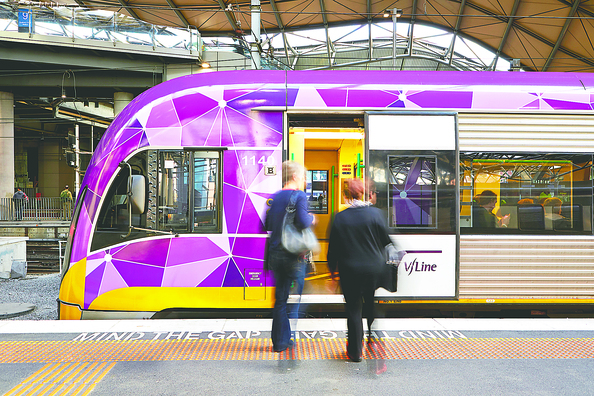
Many commuters may not realise that these sets of three are semi-permanently connected, as this achieves the required weight-mass distribution for the type of acceleration, braking, and cornering V/Line services experience. If they were to operate in any other denomination, the number of powered axles would be too many or too few for safe travel. There are only 236 seats in a three-car service.
Not all country stations along the Gippsland line can accommodate a six-car set either, which is often V/Line’s reasoning for avoiding connecting two sets together for a peak-hour service, which is why they are not seen to frequent the Gippsland corridor, despite it being the longest regular V/Line service you can take from Southern Cross.
Out of the 21 stops between Southern Cross and Bairnsdale, Garfield, Tynong, and Nar Nar Goon all have short platforms, which don’t fit the final door of a three-car service – requiring a the conductors to stands in place at that door to prevent access.
V/Line is unlikely to open up further risk of passengers stepping off onto a non-existent platform by adding more carriages, after coming under fire last September after a man broke his leg in a similar circumstance at Pyramid Hill station in the state’s North. The ongoing capacity issues were highlighted again last Sunday night, when the 7.09am service from Traralgon to Southern Cross, usually one of the few six-carriage services, was announced at 5.07pm to be running with just three carriages.
“We’re running more services than ever before to get Gippsland passengers where they need to go, with more than 100 services added to the corridor over the past year,” a V/Line spokesperson told the Express.
“We continue to closely monitor patronage across the network over coming weeks and where possible, have coaches on standby at key locations to assist passengers.”
Those with enough petrol to give PT the flick on the Wednesday may have burnt some unnecessary fuel sitting in traffic, after the Princes Freeway at Officer was closed the day before (April 7) in all outbound lanes due to a multi-vehicle collision.
Those heading towards Gippsland were advised to leave the freeway at Berwick and detour via the Princes Highway through Officer and Pakenham. The incident was between two trucks, which experienced enough impact to dislodge the trailer from one of the cabs, and seriously injured one of the drivers involved, requiring an ambulance airlift.
With both rail and road networks impacted across consecutive days, Gippsland commuters faced limited options, as ongoing disruptions continue to test the reliability of key transport routes in and out of Melbourne.
Last week was the first of the month without day-long disruptions of any sort, only seeing one service terminating early and another cancelled (both on Thursday, April 16).