


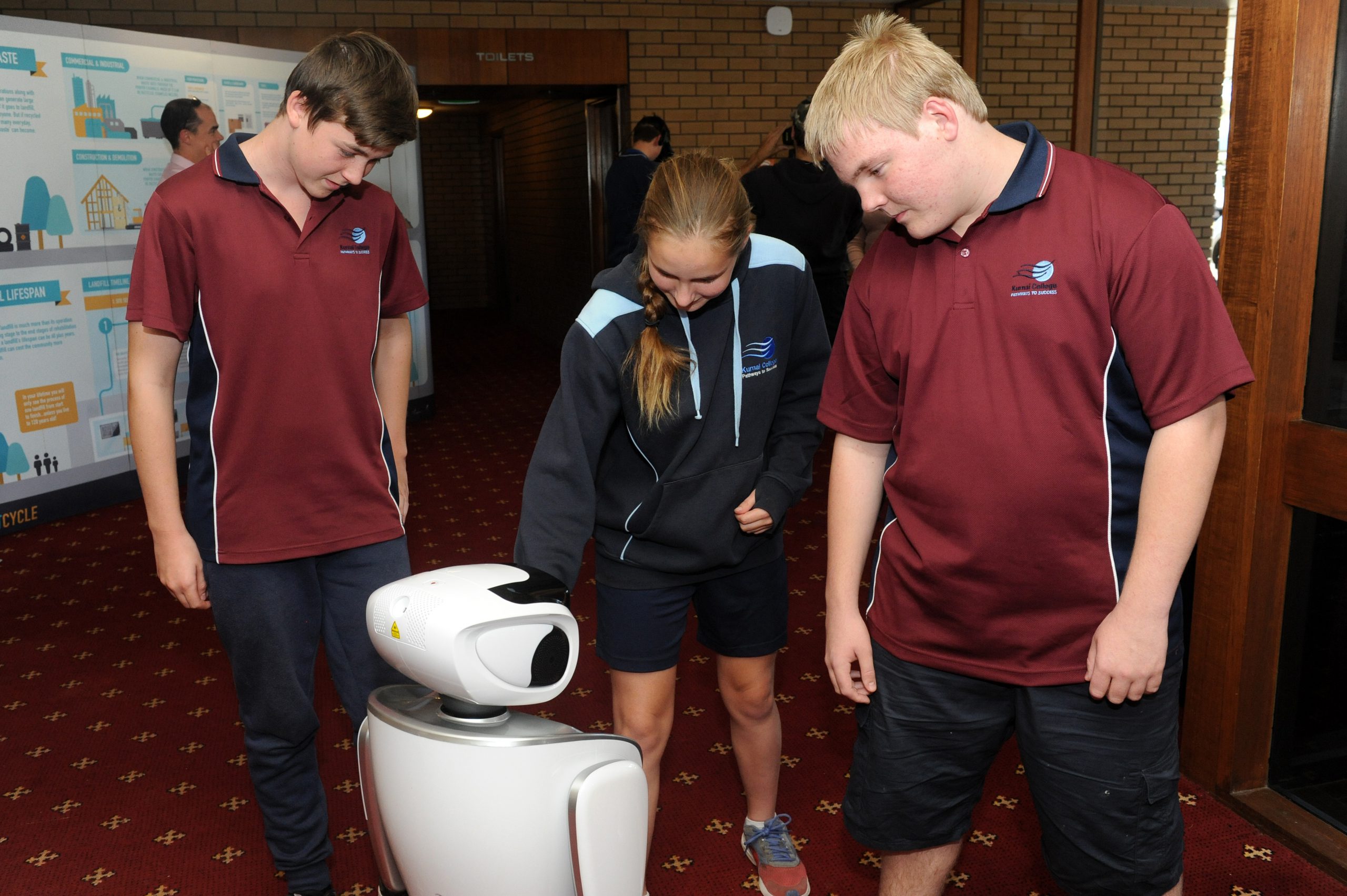
The soon-to-be-completed Gippsland Tech School provided some year 9 and 10 students from across the region with a taste of what the school will have to offer when it opens with a forum tackling Australia’s recycling crisis.
Held at Kernot Hall next to the tech school, which is set to open next term, and in partnership with Federation Training, students explored new ways to approach Australia’s recycling processes in the wake of the China recycling ban.
Gippsland Tech School director Paul Boys said students were given some background on waste processes in Australia after which they were encouraged to come up with a topic of interest and work on the challenges the topic presented.
“Recently China refused to import Australian waste so we are looking at ways we can better manage our waste locally so that we don’t have the issue on an international scale,” he said.
“Some students focused on how we can better manage e-waste, electronic waste … things like computers, printers, iPhones.
“We showed them some footage of how a lot of our material ends up in Africa. It is actually maintained and broken apart by young children who are then getting ill and sick from that so the kids were quite surprised and … they are looking now at how they can better manage their e-waste as it is going to become a huge issue.
“There are some very toxic materials inside those products so managing those is very important.”
Mr Boys said the recycling forum aimed to prepare students for future careers and work.
“It is really important to engage [students] in that space and make them really aware of how things are approached in industry. We are trying to bring that real-world experience in,” he said.
“Kids think differently to us as well. I think they are probably less conditioned to think and act in a particular way so they are actually free-er in the way they respond – we’ve found that they generally provide a bit of a left-of-field or a bit of a different approach to it.
Mr Boys said students had come up with some innovative ways to tackle the recycling problem facing the nation.
“One which was quite simple was just increasing the size of labels on products, so people are really aware of what the recycling component is, and breaking it down, so actually showing 40 per cent of this is recyclable, 80 per cent is,” he said.
“Kids were thinking about when you purchase the product, putting an end of life cost in there, so a $30 fee included in the purchase price which means at the end your product will be recycled, so the manufacturer essentially collects the money, keeps it, on-sells it to be used by recycling facilities.”