



CRICKET
VETERANS
By LIAM DURKIN
IT’S like riding a bike.
Just because they are older than 50, doesn’t mean they can’t still play a high level of cricket.
While people of a certain generation might not like to freely admit it, there are a number of gun A Grade cricketers not far off getting their seniors pension card.
Anthony Bloomfield continues to churn out runs for Latrobe, while in the Sale-Maffra Cricket Association, Steve Spoljaric is still arguably one of Gippsland’s most accomplished players.
The SMCA won the 2020/21 senior GCL premiership with a team of mostly over 40s.
The team included Spoljaric, Adrian Burgiel, Nathan Massey and Sam Anstee.
SMCA great and North Melbourne premiership player Stuart Anderson is back playing first grade cricket this season. His son Sam recently made his Victorian Premier Cricket First XI debut for Melbourne, following in his father’s footsteps.
Bloomfield’s teammate in the Gippsland Goannas over 50s, Graeme Rankin, already has a First XI century to his name this season in the Warragul District Cricket Association.
Latrobe Cricket Club legend, the late Graham Freshwater, played A Grade until he was 63.
Raiders hexad veterans Brad Knowles, Jock Macfarlane, Mick Higgins, Chris Stanlake, Jamie Winters and Tim Darby were all still playing in the top available division at the start of this decade.
Knowles won the then Latrobe Valley District Cricket League Premier A player of the year in season 2021/22 at age 41.
Morwell’s own Peter Siddle is still playing professional cricket at the same age.
With the Latrobe Valley welcoming the national over 60s cricket championships this week, it is perhaps timely to debunk the myth that veteran cricketers are just tragics trying to cling onto their youth.
While some players over a particular age might lack the agility and exuberance of their younger counterparts, many more than make up for it with their experience and craft.
National over 70s player Kevin Lanigan, from Maffra, said the knowledge acquired from playing cricket for so long meant certain players were able to perform, regardless of age.
Lanigan pointed to his time playing with former Australian captain Graham Yallop and SMCA legend Blair Campbell as cases in point.
“Graham Yallop batted and hit the ball as beautifully and timed it as well at 60 as he did at 30,” he said.
“Blair was about 56 and he still bowled excellently, 90 per cent of people couldn’t pick his wrong-in.”
When asked if he thought players in the Goannas over 60s team could face the average club A Grade bowler, Lanigan believed most would be able to, provided they weren’t bowling express pace.
“The reflexes are just slower (as you get older),” he said.
“People who are regarded as a medium pacer all of a sudden are a quick bowler.
“The mind says do this but the body says you can’t.
“When I played my better cricket I always batted in the first four, but when I finished playing first grade I was at seven or eight – because of the fact you batted after tea when the ball is older.”
With the slower reflexes in mind, many club cricketers who take to the field on a Saturday will attest to the number of late cuts veteran players seem to execute.
Naturally, it has become known as “the old man shot”.
As well as the late cut, cricketers of a particular vintage are easily spotted at club level, with well worn equipment and forgotten brands such as Fisher, Screaming Cat and Hunts doing the rounds.
The territory does come with a few perks, and once you reach a certain age in club cricket, it seems you are granted a few luxuries, such as fielding exclusively in the slips and being allowed to return the ball from the outfield with a bowling action.
Running and throwing were indeed the two main differences, according to Gippsland Goannas player and Express veterans cricket scribe Gordon Cowling.
“You don’t lose the ability to do stuff – you just get slower at doing it,” he said.
“There are very few of us who are good runners and good throwers, it’s only those that have kept going who can do that.”
Given so many local cricketers in their 40s and 50s are still performing at first grade level, the ‘you are never too old’ adage appears to be ringing true.
In fact, players as old as 60 and 70 can tell their grandkids they technically play cricket for Australia if they happen to be selected for a veterans national tour.
Like the ICC ranked team, Australia’s over 60s and 70s play for the Ashes against England, with the over 60s playing for the ‘grey Ashes’ and the over 70s the ‘silver ashes’.
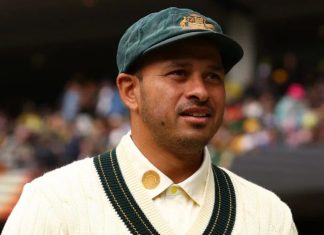
For the boy who grew up dreaming of wearing the baggy green cap, they are still able to do it at the ripe old age of 70.
Unlike more physical sports, cricket allows players from various generations the chance to either play with or alongside one another, something Lanigan believed was one of its biggest draw cards.
“If you love the game, don’t ever give it away,” he said.
“There is a pathway for juniors coming up and there is a pathway for the elderly going out.”